Managing form responses
In this article
Managing responses
Linking responses
Editing responses
Archiving responses
Updating people's details from form responses
Communicating with people with linked responses
Adding form actions
Conditional actions
Running actions manually
Managing responses
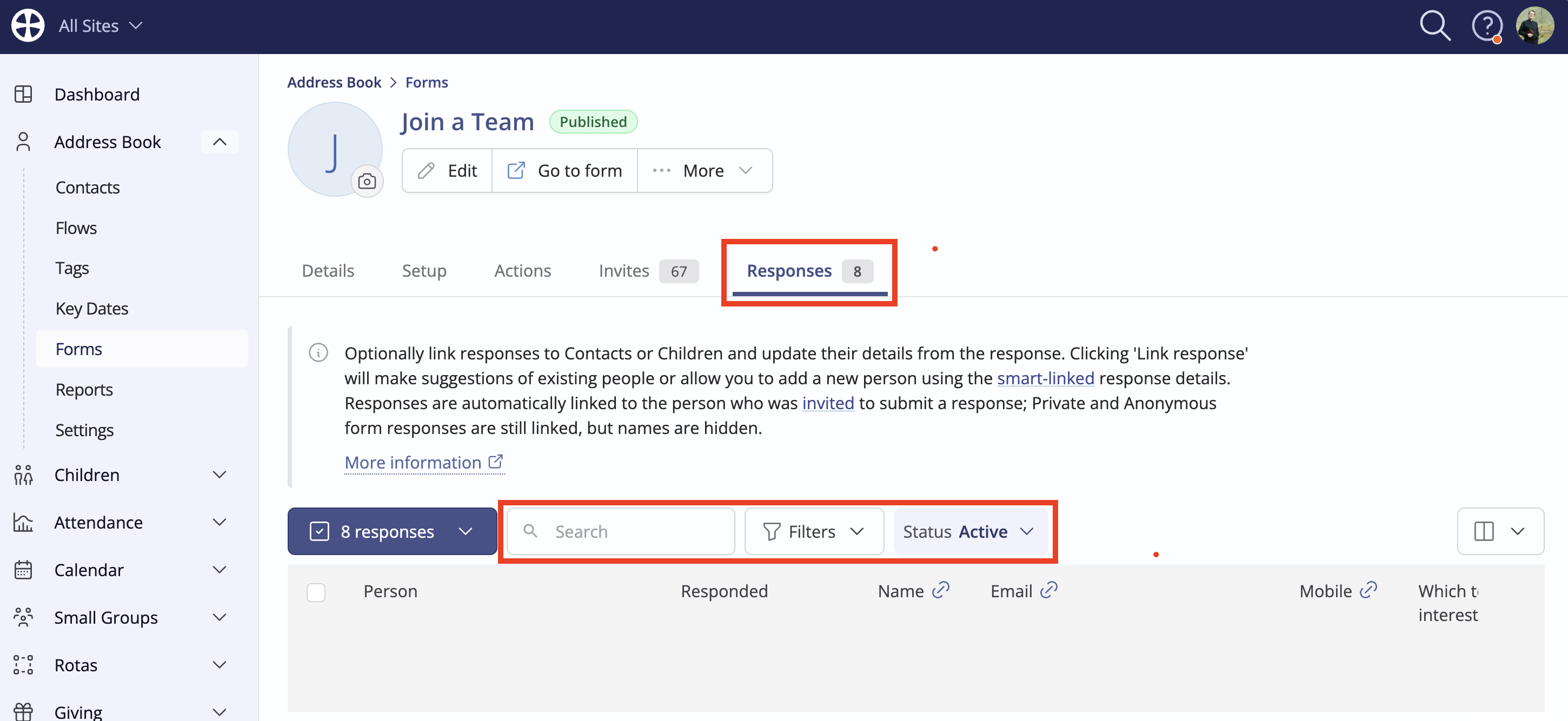
Form responses received are shown on the Responses tab of the form View, with the most recent response first in the list. Use the Status Search and Filters to further filter a long list to find a particular response of interest.
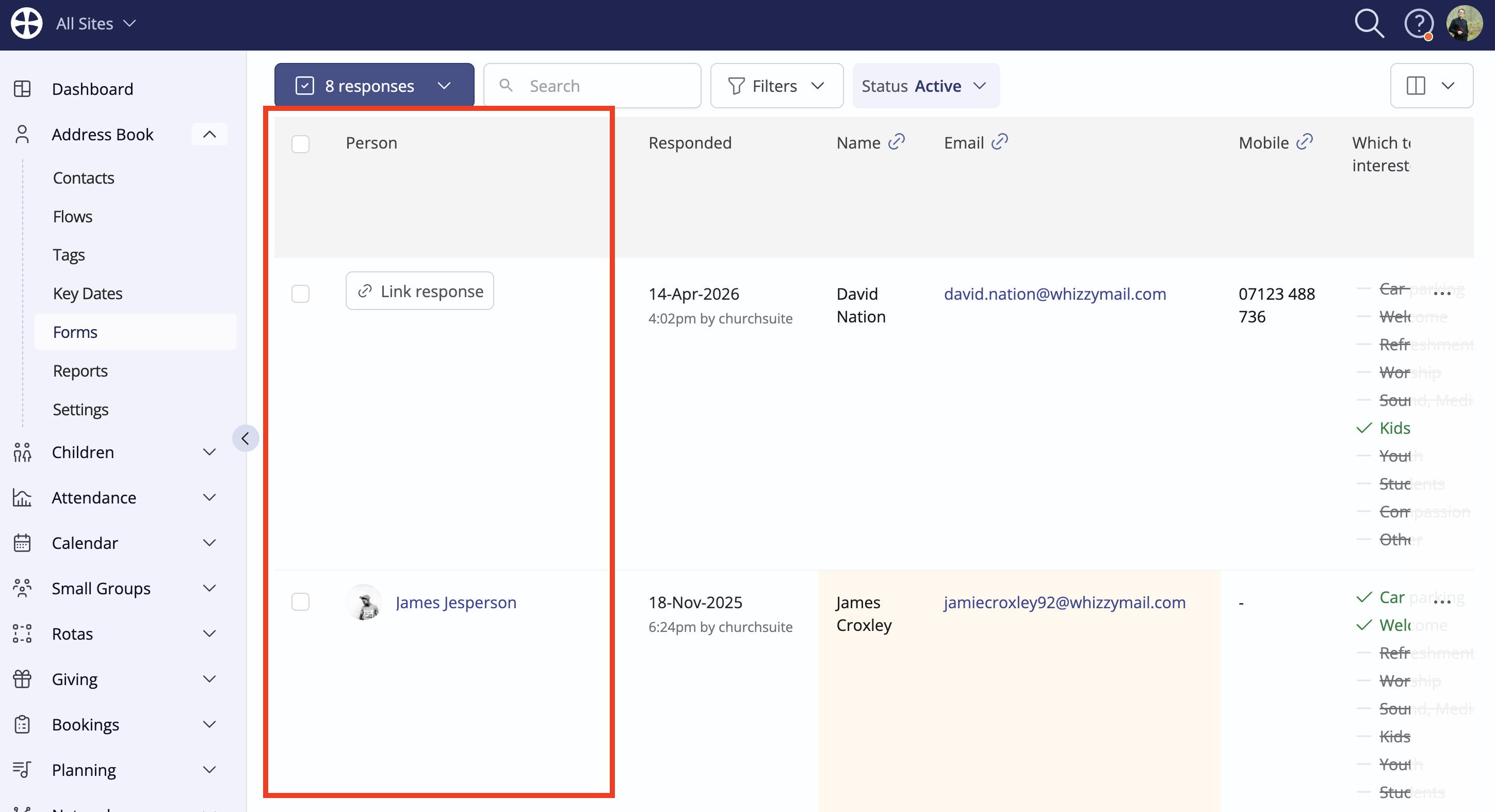
You can also use the bulk actions to Download a CSV or Print a PDF of the full responses list.
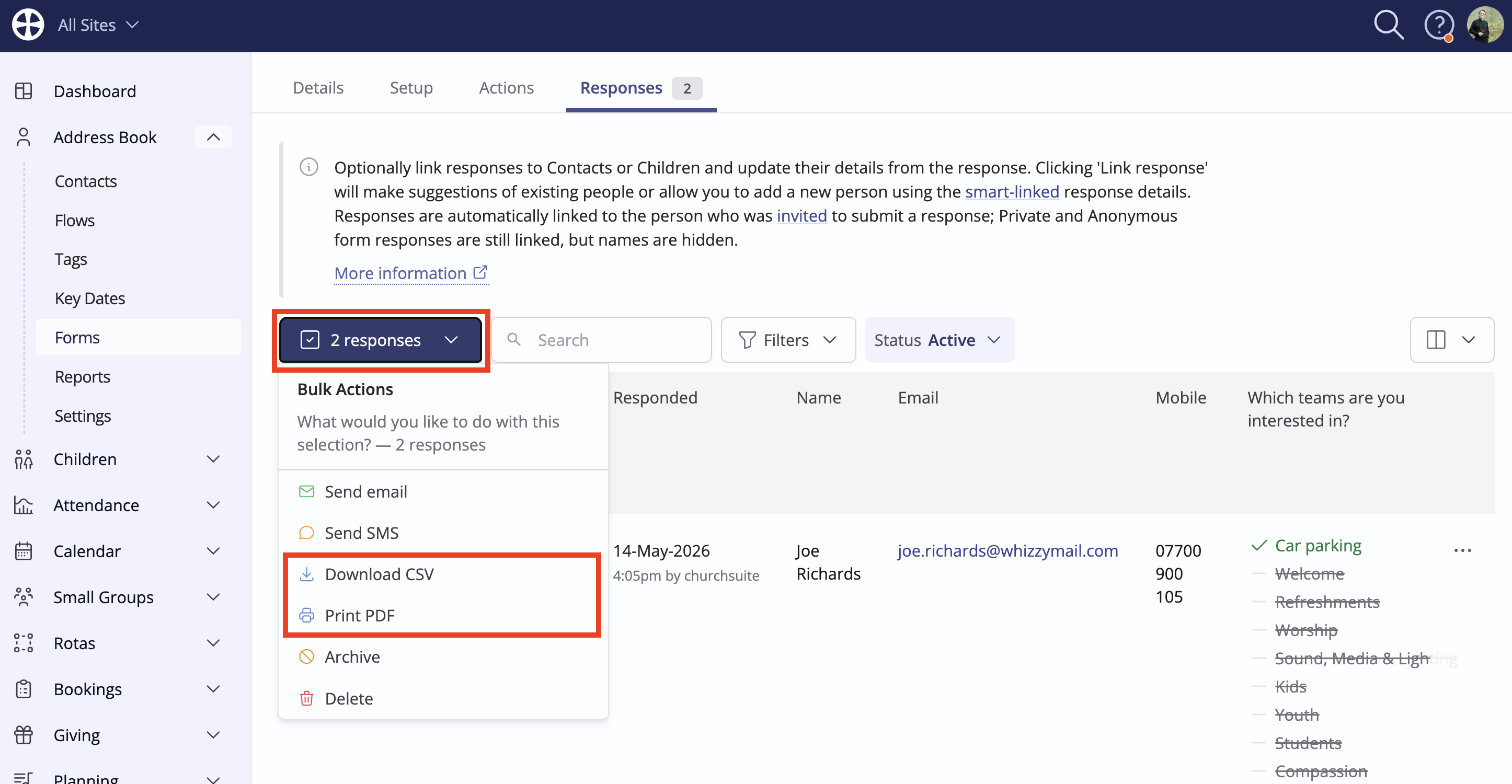
For Public and Private (i.e. non-anonymous) forms, there is a Person column and a Responded column showing the date and time of the response. Responses to a form invitation and responses to a non-invitation form where there is a definitive match between the respondent's details and a unique person already in ChurchSuite are auto-linked. If there is no definitive match to an existing person, the response fails safe and displays Link response. Linking is optional but you will be unable to run actions against or the respondent until their response is linked, as explained in the next section.
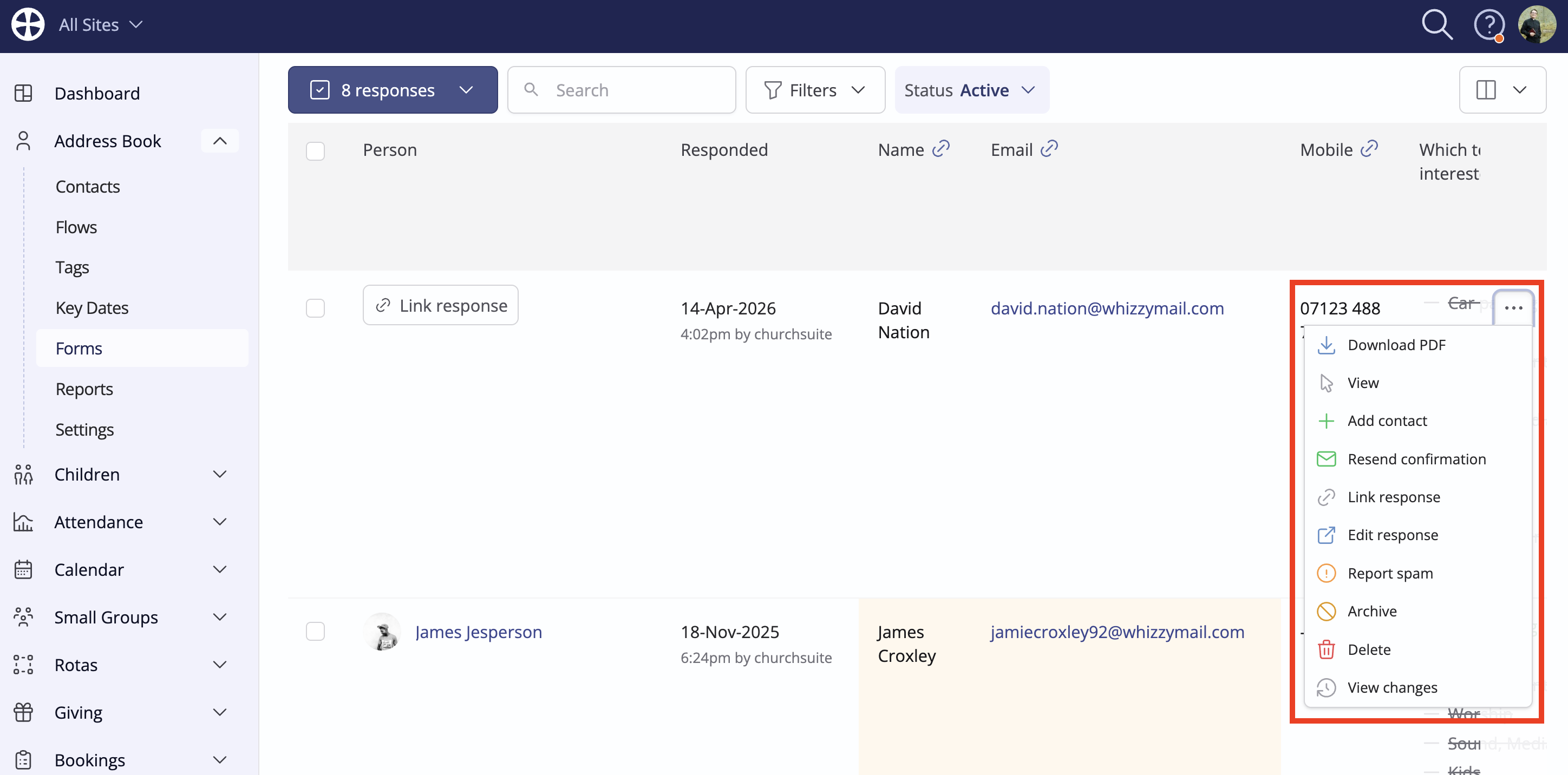
The response Actions available, explained in this article, depend on the form's Primary Response Type, whether the response is linked to an Address Book contact or a child in the Children module and the response status.
Good to know! Handling spam responses
When reviewing form responses, particularly those collected from a form embedded on your website, you may, from time to time, experience submissions that you consider to be spam. You can flag and report a form response as spam using the available response action, shown below:
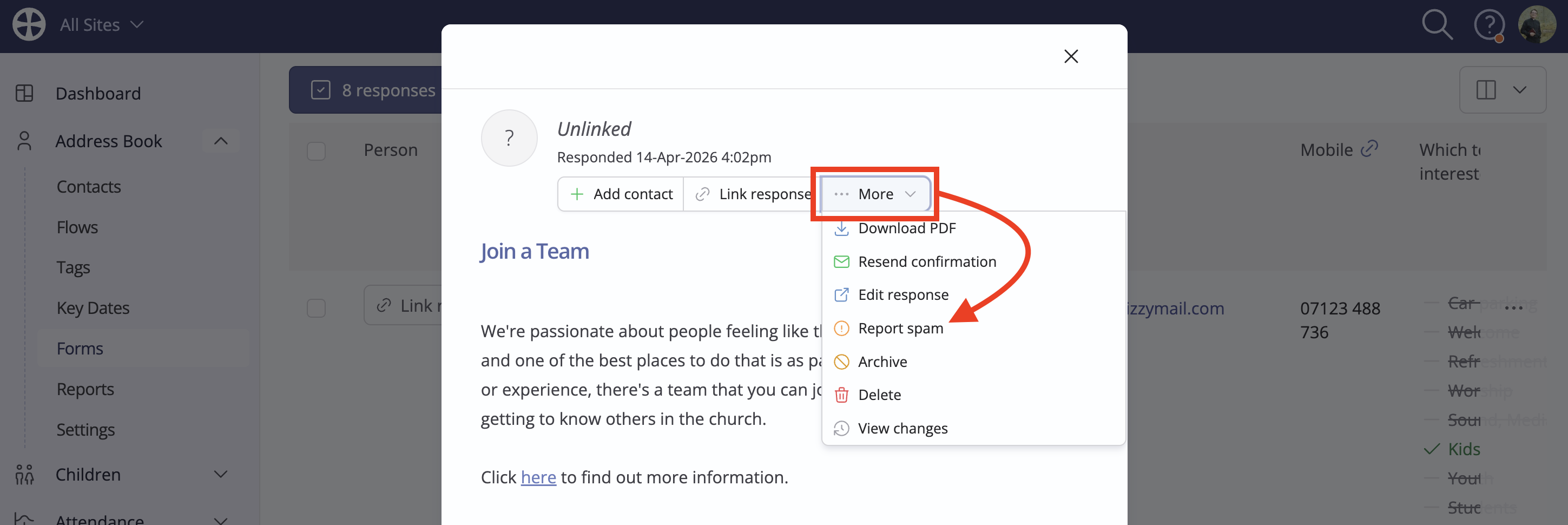
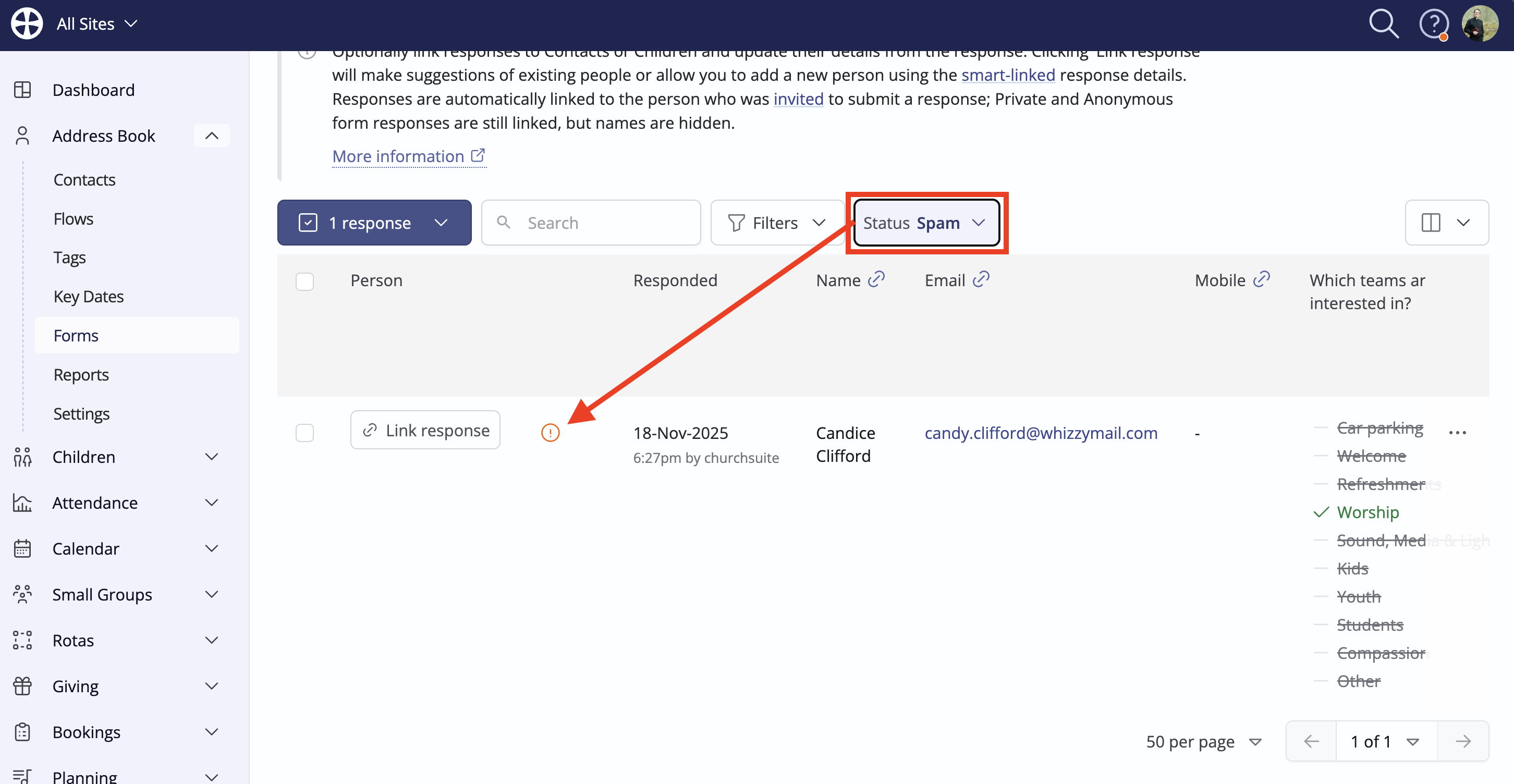
Marking a response as spam updates the status to 'Spam', so it no longer displays in the 'Active' Responses list. Responses marked as spam are reported to our Account Monitoring systems and may be used to help improve form response security. You can set a spam response active again, if required.
Linking responses
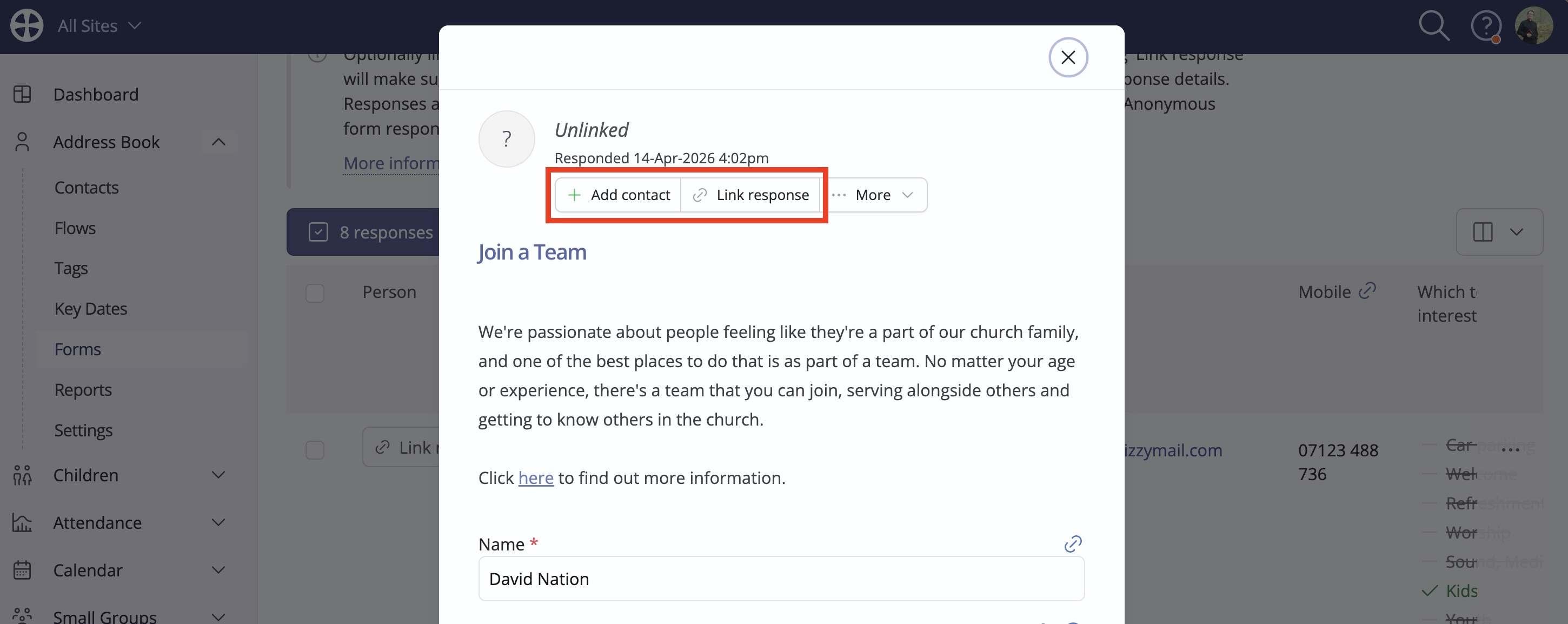
Click on a response to open it to View in a pop-up. For Unlinked responses, note that you can select to Add [person] or select Link response to locate an existing person to link to:
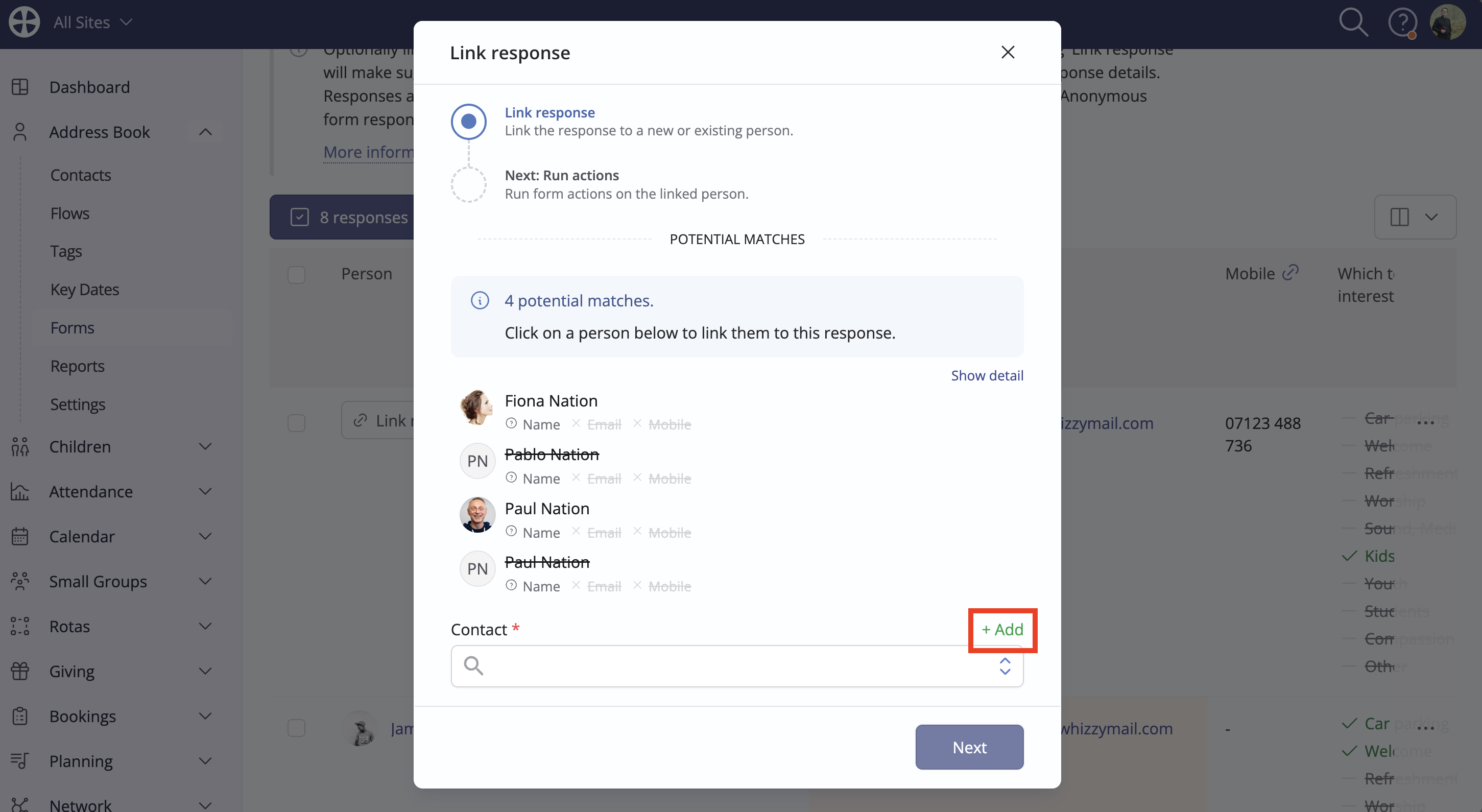
The Link response pop-up displays linking suggestions from the existing people in ChurchSuite and the matching criteria for each person. From here, you can select a person from the suggestion list or use the Search to locate an existing person to link the response to. If the person does not yet exist, click Save; if, as in the below example, the form has associated actions, click Next to process those actions - see our related article Form actions for further information:
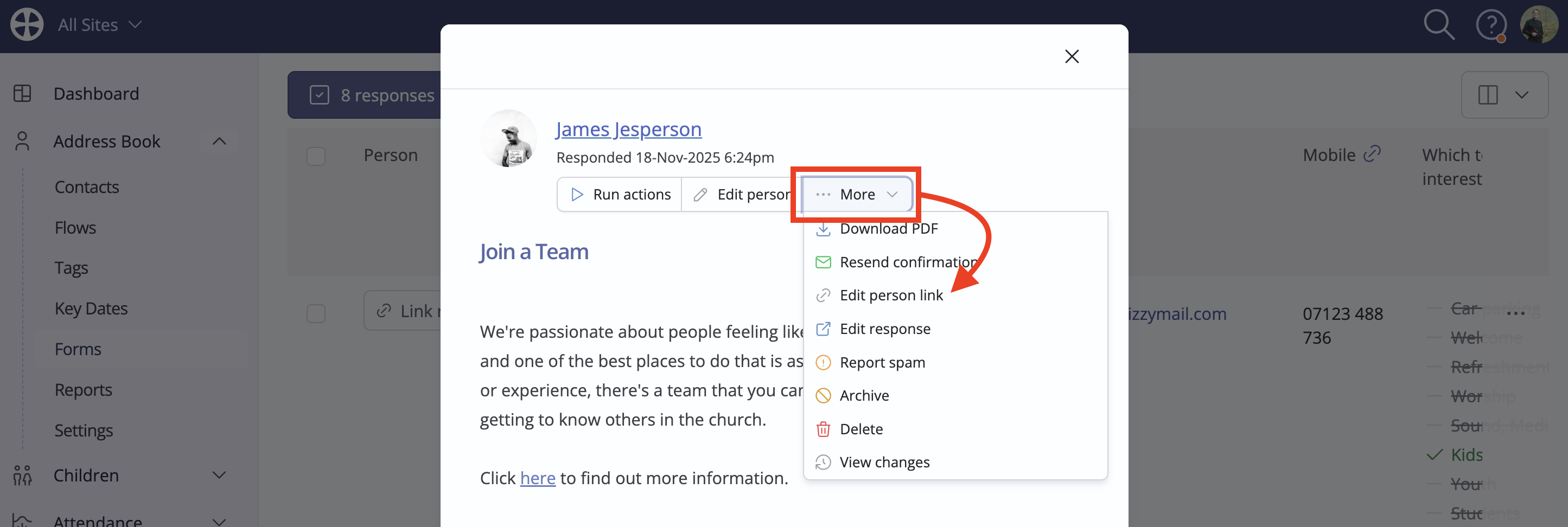
You can also change who a response is linked to or unlink a response entirely using the Edit person link option.
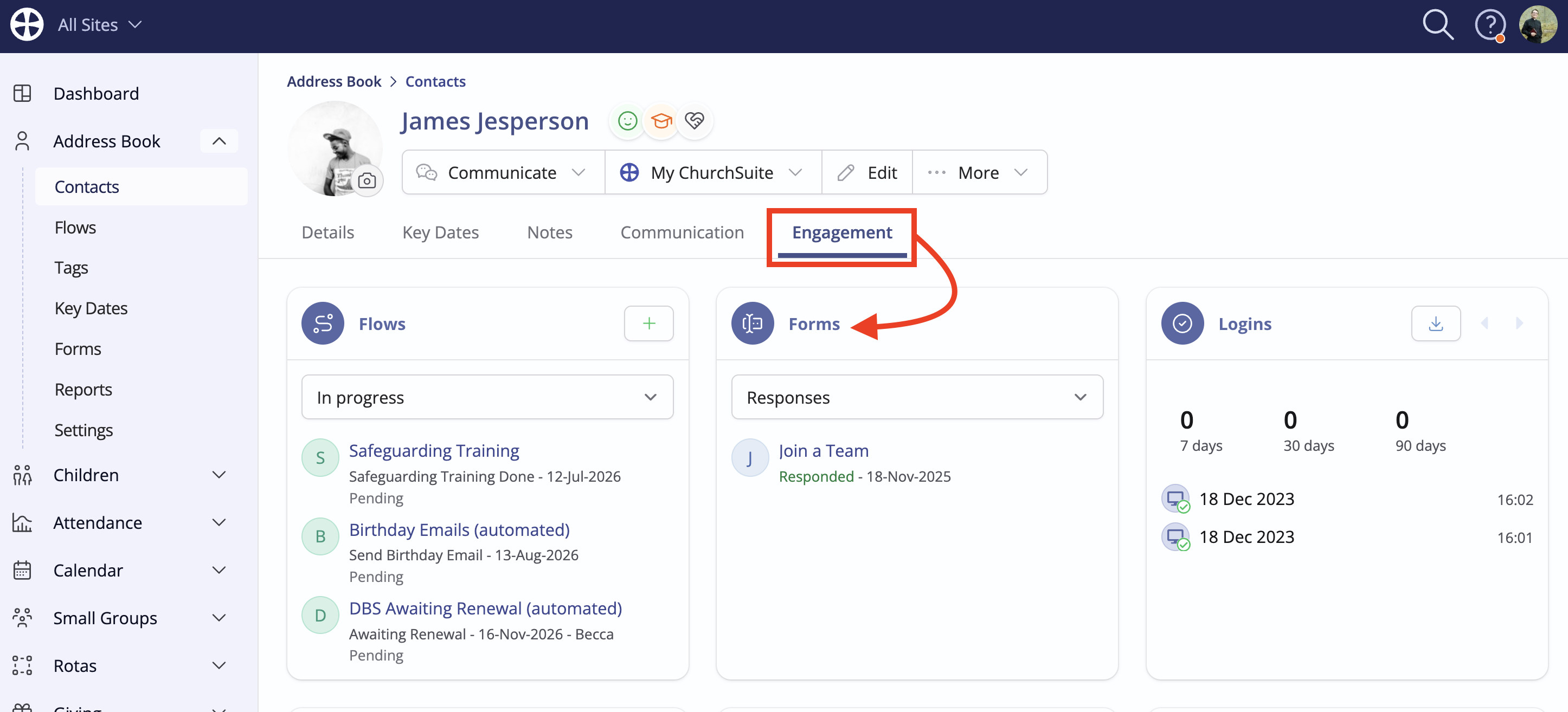
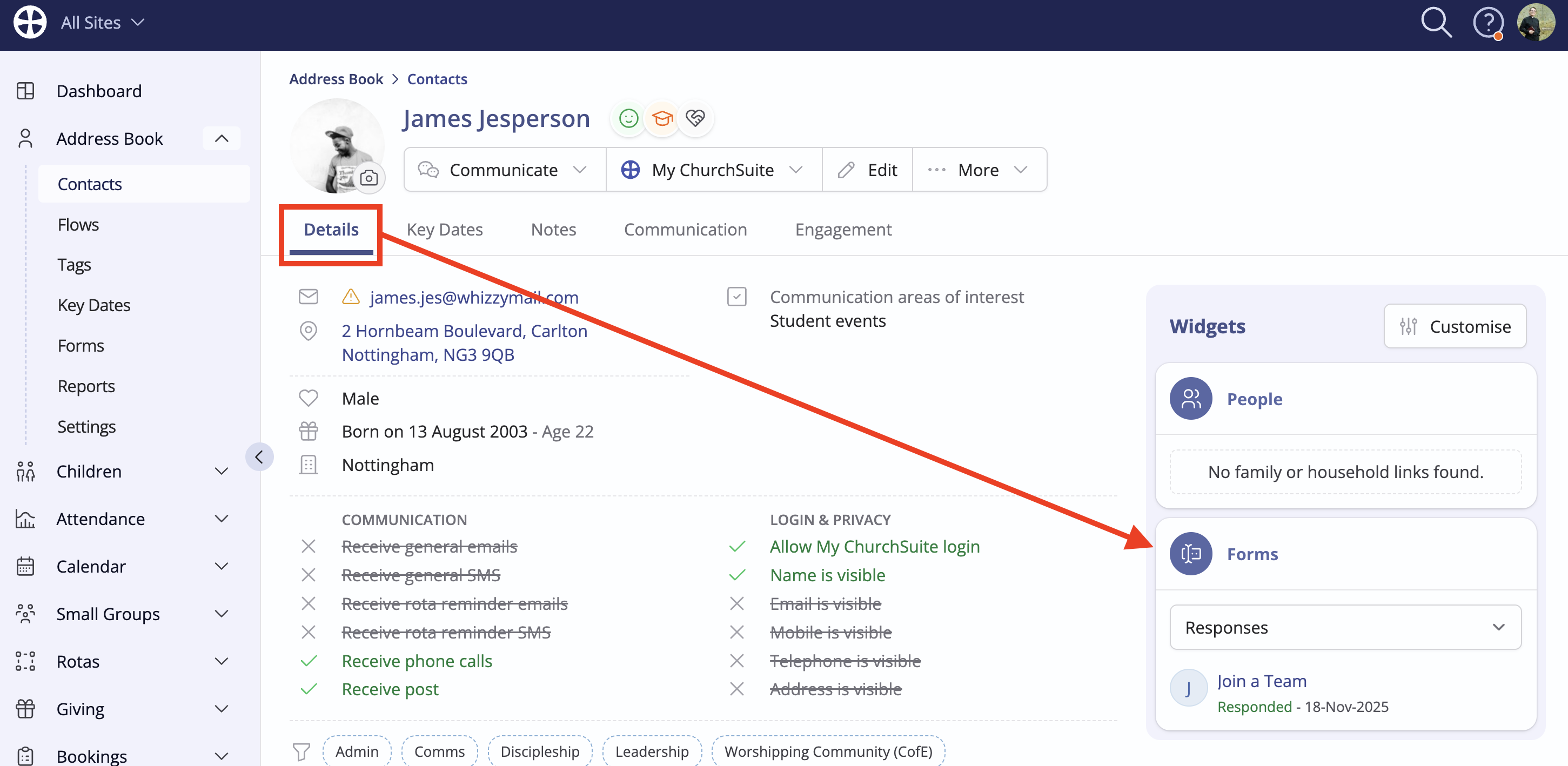
Linked responses are shown on the Forms widget on the Engagement tab of a person's profile page in the Address Book or Children module, or the Details tab Forms widget. The widget shows the most recent Responses - or switch to see recent Invites. Clicking on a response or invite redirects you to the Responses tab of the form, subject to any form visibility restrictions.
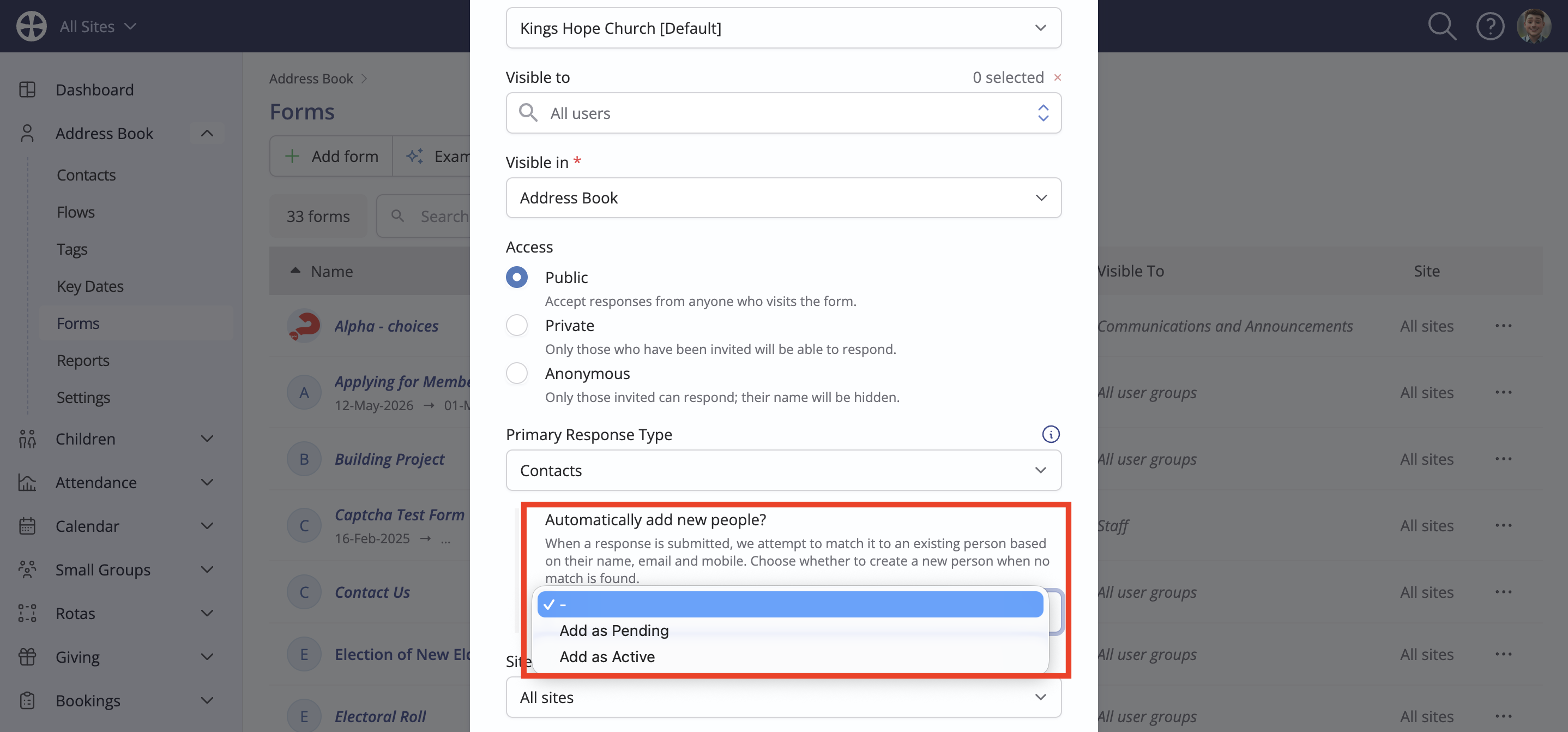
Automatically add new people?
When a response is submitted, we attempt to match it to an existing person based on their name, email and mobile. However, if a response is submitted without any details that match an existing contact/child, then their response is saved as an unlinked response. You can instead choose to Automatically add new people to the relevant module when an unlinked response is submitted, and whether they are added as a pending or active contact/child.
Editing responses
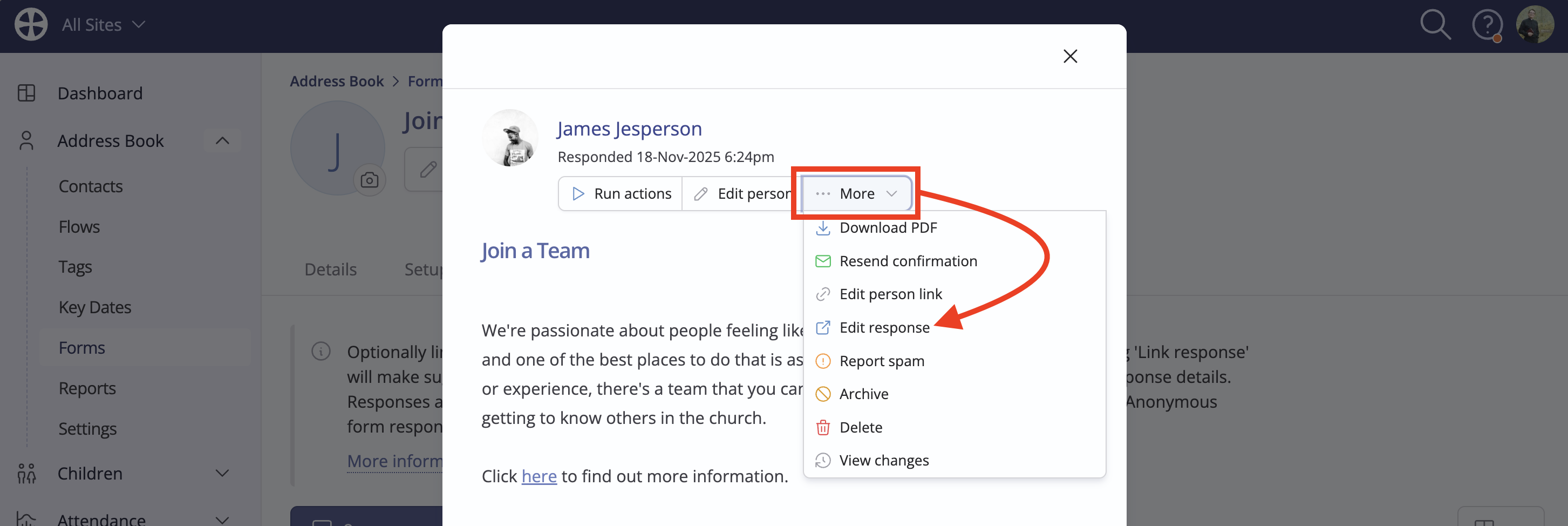
If you need to edit a person's previously submitted form response, you can do so using the Edit response action found in the More response actions list.
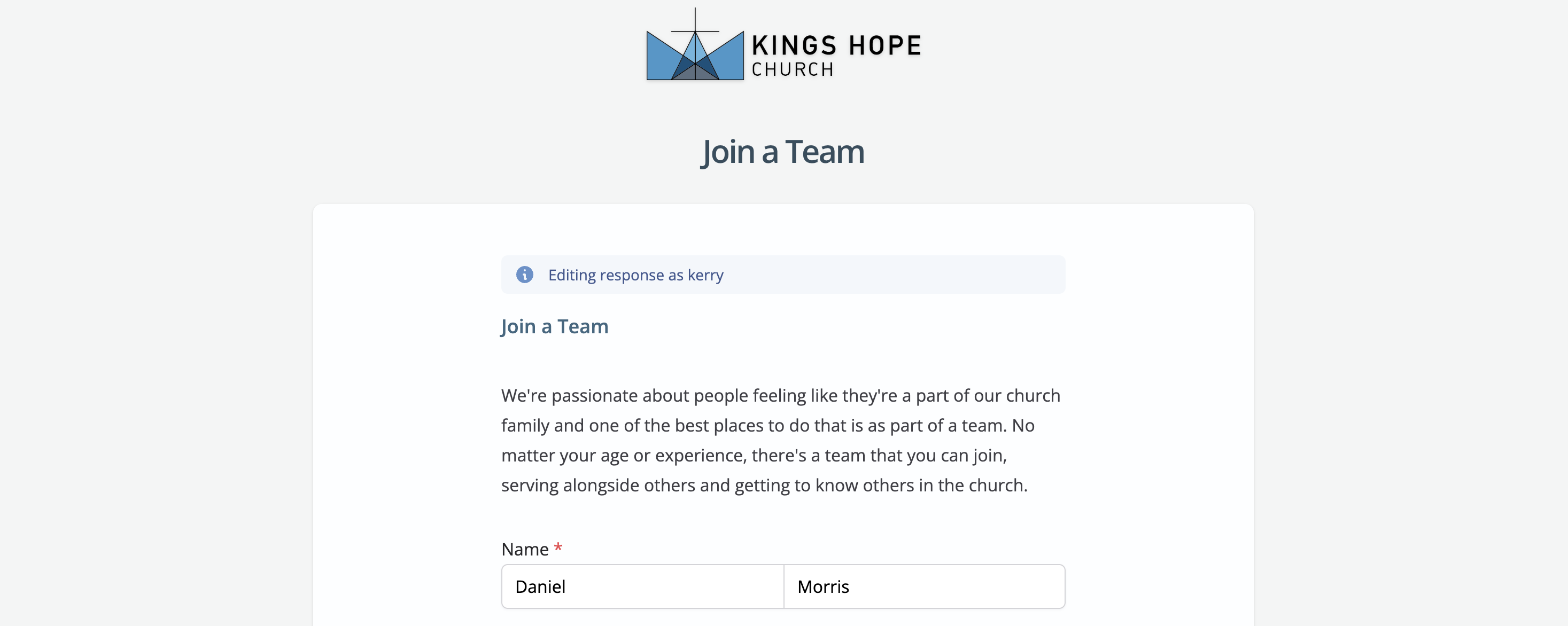
Selecting Edit response opens the form populated with the existing response data:
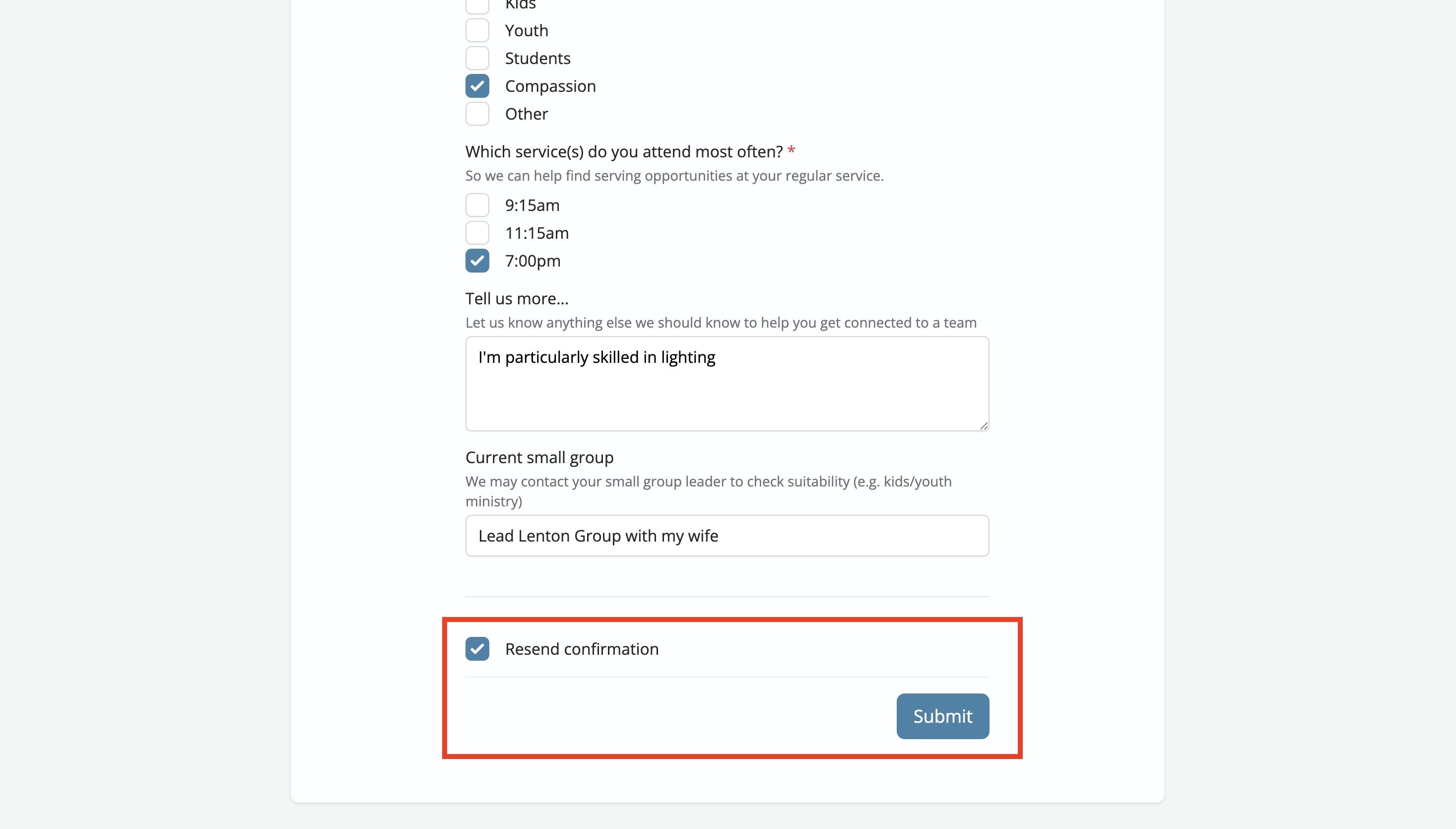
A Resend confirmation checkbox, ticked by default, sends a change confirmation email to the respondent. Note that any data protection elements present on the form are not displayed in this context, where a user is making changes to a response.
Response change logs are maintained, detailing user changes made to a response.
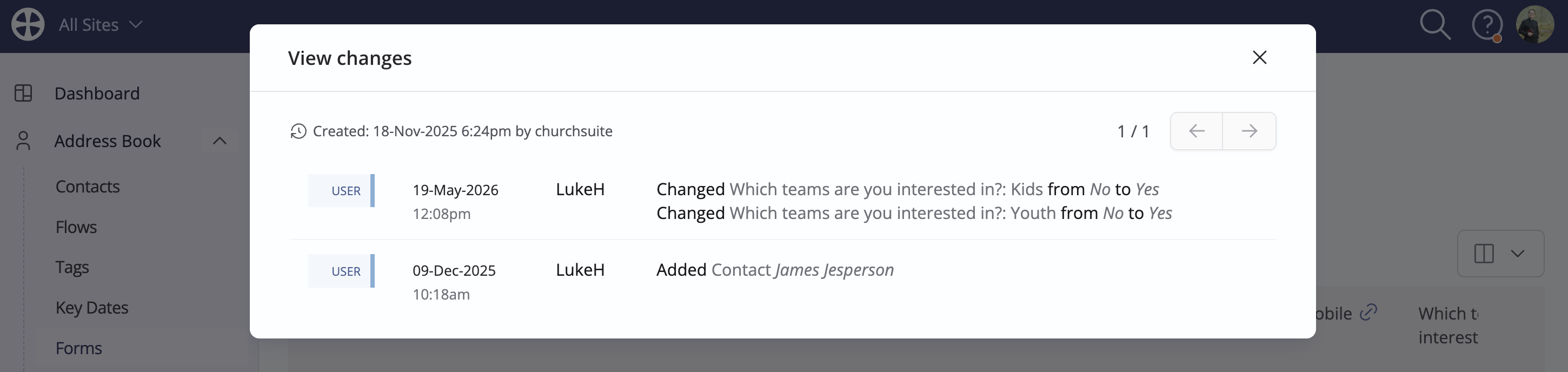
Please note that it is not possible to edit a response if the form has an end date that has already passed.
Archiving responses
To help distinguish responses that have been fully actioned from those that still need action, you can Archive responses. Archived responses can be Set as active again if necessary. Note that you can only Run actions for an Active response.
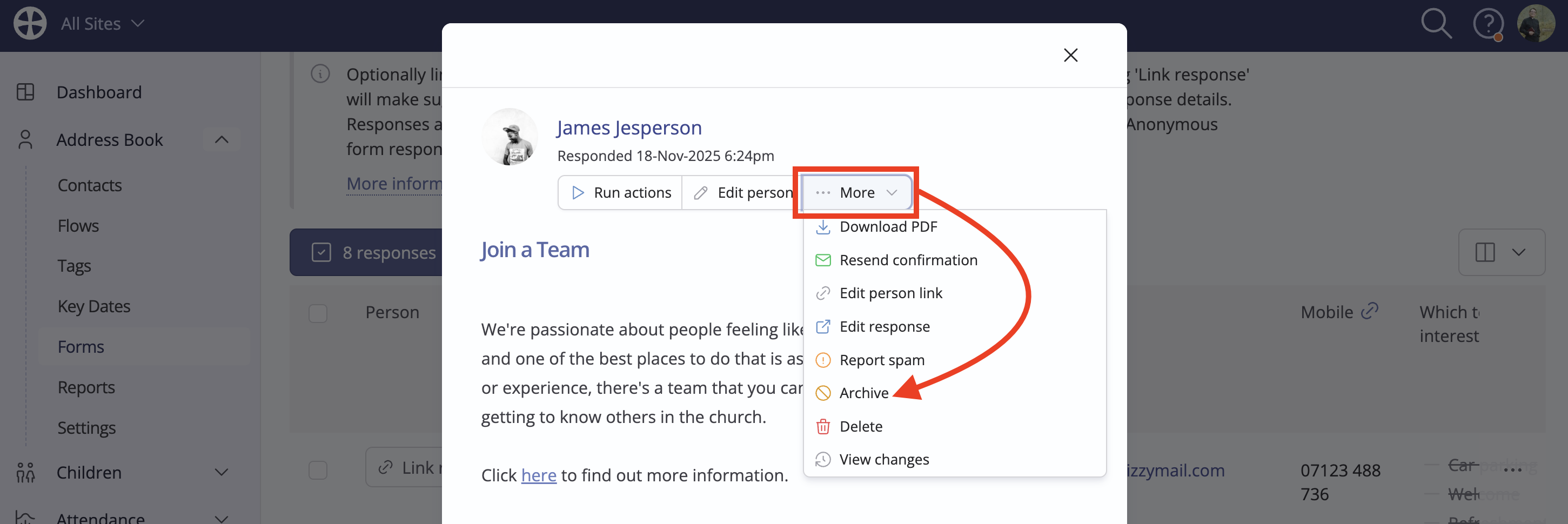
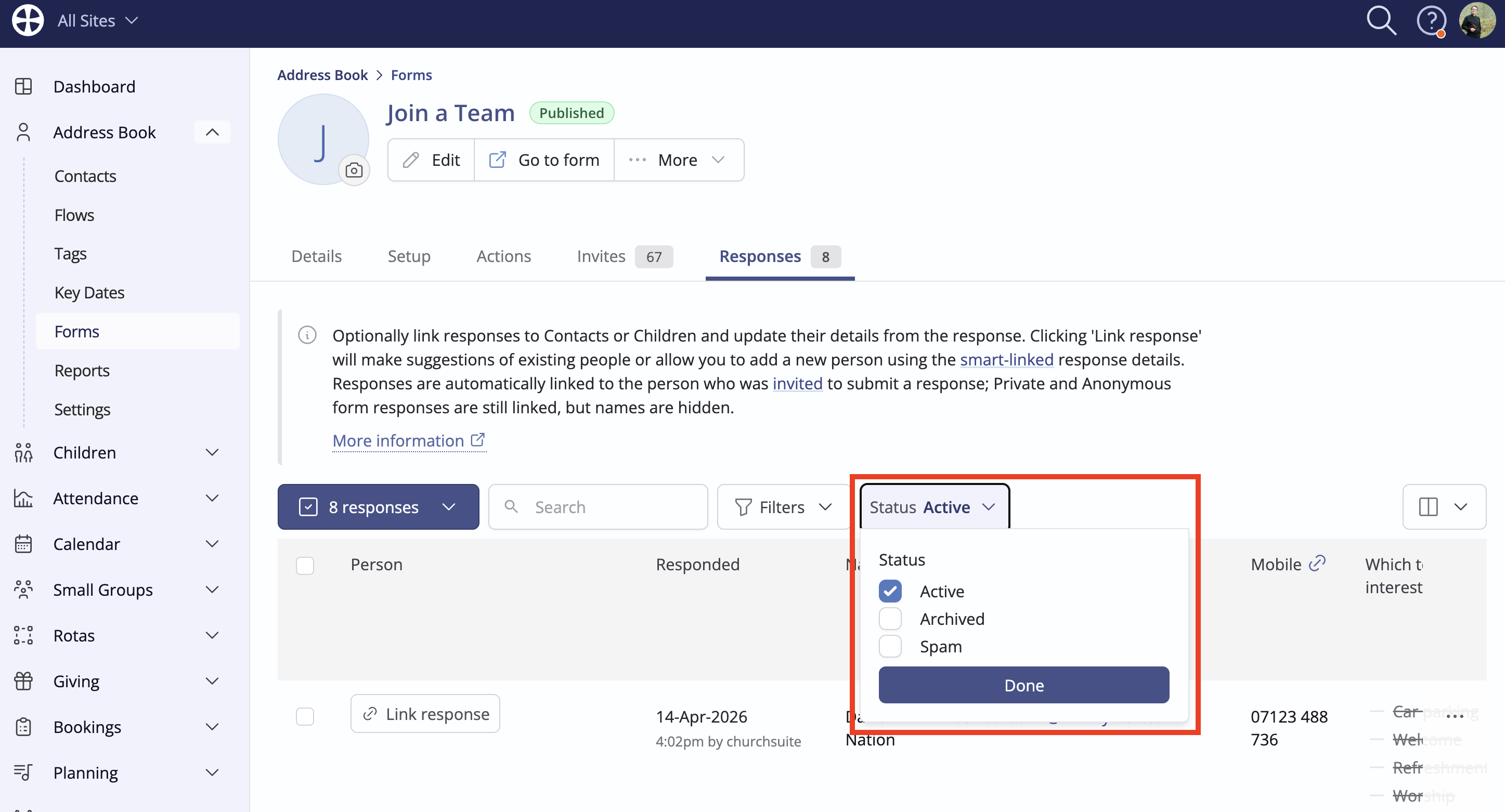
Working within the Responses tab of a form, you can switch between viewing Active (the default) or Archived responses.
Updating people's details from form responses
As explained in the related support article, Creating forms, the fields on your form can be optionally smart-linked to the corresponding fields in ChurchSuite. Response data from smart-linked fields allows you to populate the fields on a new person's profile when adding a new contact or child, or to use the Edit person action to update a linked respondent's existing details when there are differences between their existing details and their smart-linked response data. In this way, form responses can help keep people's details up to date. However, consideration should be given to whether a difference is intended to be a permanent update to a linked respondent's details. For example, when a response contains a different email address, should the person's existing email address be updated? The consideration here is that a change of email address will prevent that respondent from logging into My ChurchSuite with their original email address. Remember, people with My ChurchSuite access can securely self-manage intended changes to their personal details, so you should carefully consider whether to treat a form response as a permission to update someone's details.
You can easily identify differences and selectively choose which data to update or leave unchanged. Smart-linked response data that differs from the linked person's existing data is highlighted in yellow-orange on the Responses tab. Differences include the use of uppercase and lowercase data and, where there is missing data, either missing from a smart-linked response field or missing in the linked person's existing details in your ChurchSuite modules.
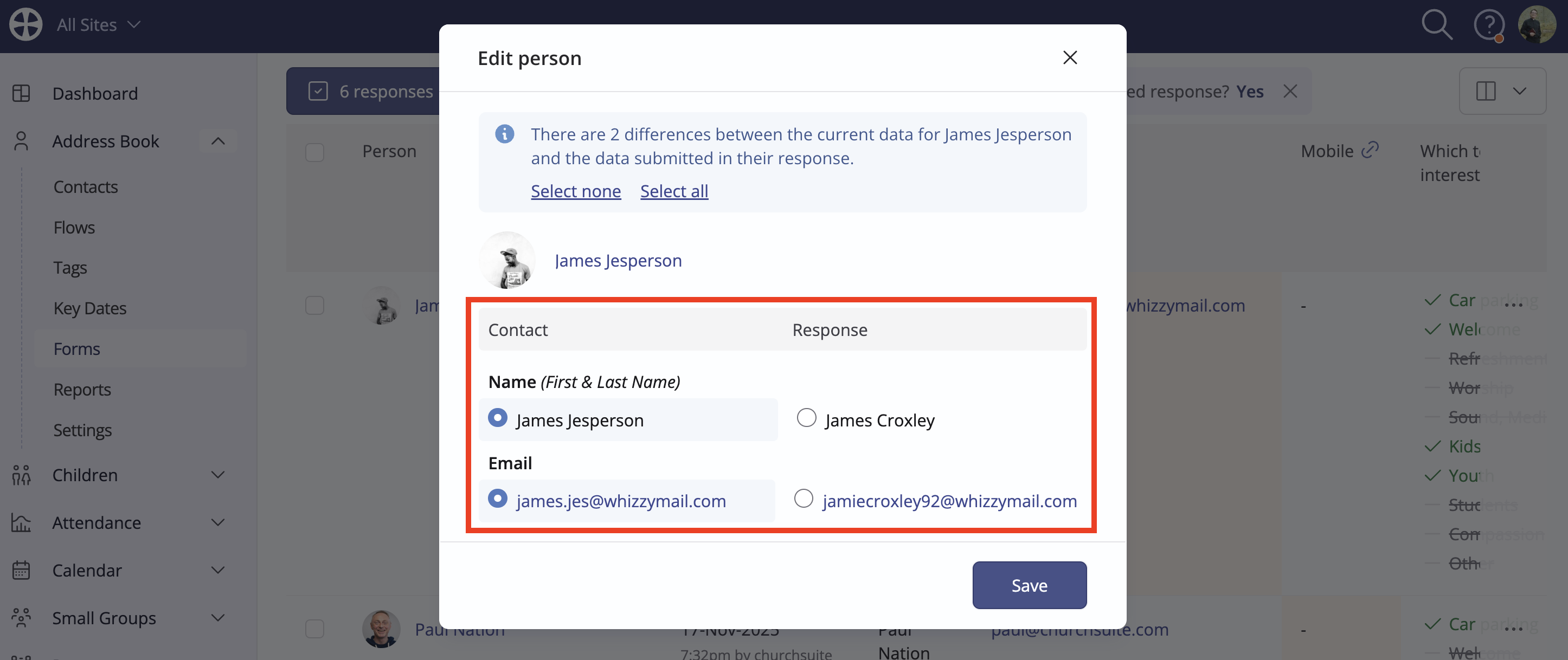
The same styling of differences in data is shown in the response View for a linked response. Click Edit person to view a full list of the differences.
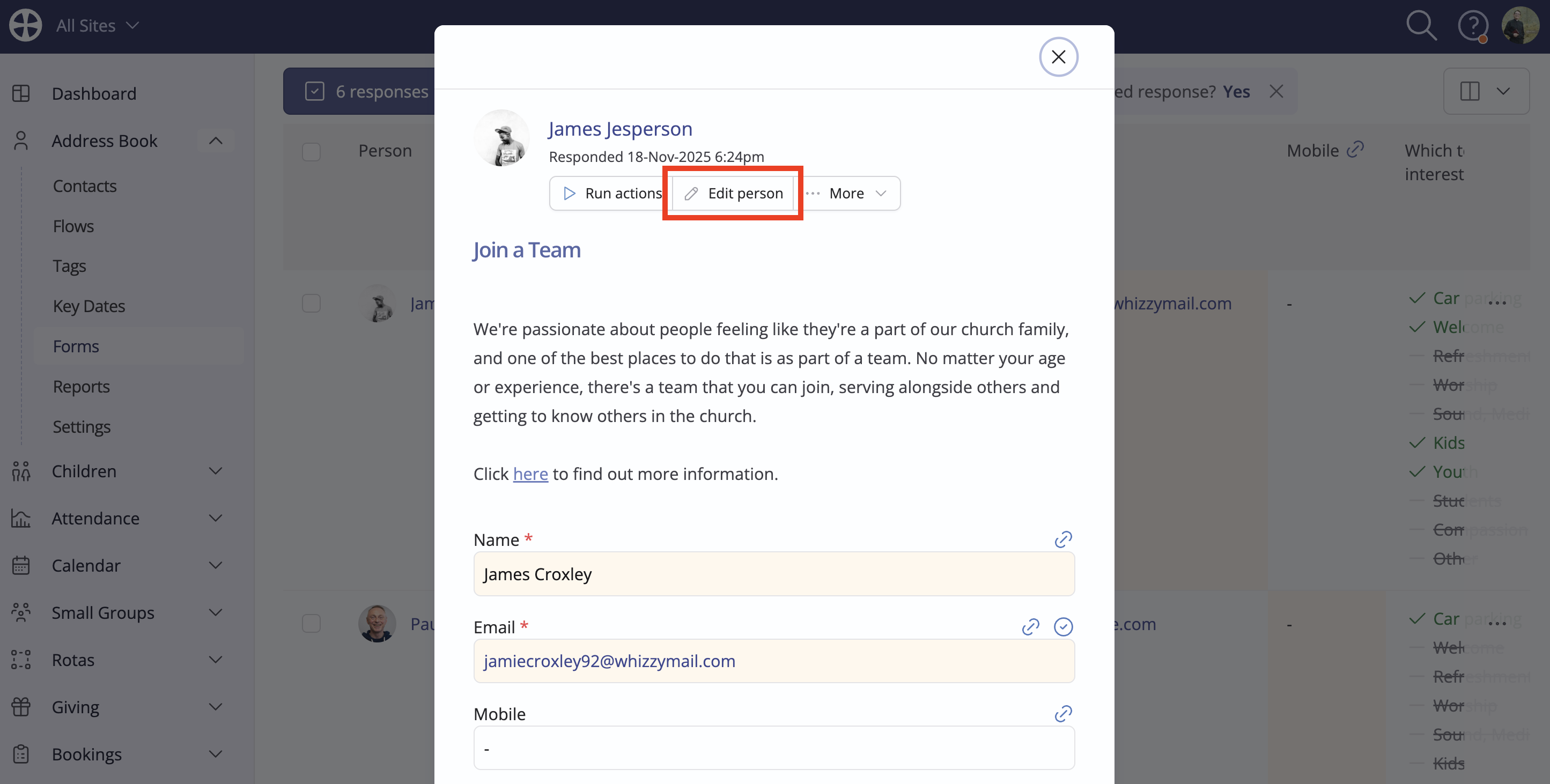
The Edit person pop-up shows any differences between the linked Contact or Child and their Response. By default, their existing data is preselected but you can selectively choose to update any of the existing data in the response data. Click Save to process the changes. Change logs are maintained against the linked person's profile for any changes made.
Communicating with people with linked responses
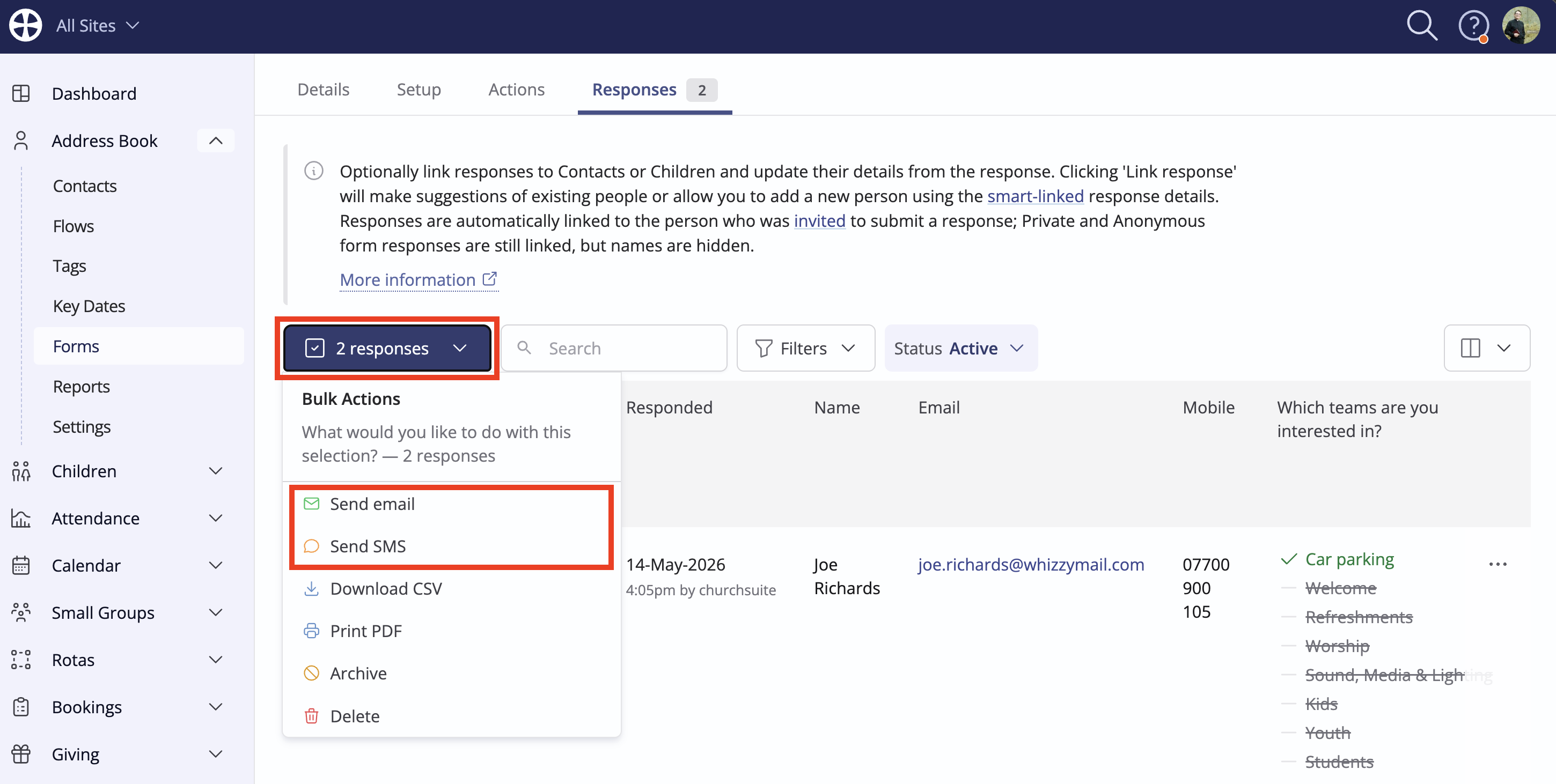
Finally, it's possible to use the bulk actions to communicate with people who have responded to your form by Email or SMS. It's only possible to communicate with people with linked responses (unlinked responses will not receive any communication).
Adding form actions
You can add a level of automation to Forms by defining Actions that run Automatically (always), Conditionally or Manually when a response is received. The actions available for Forms and Flows are the same. Actions can only be run for Active responses.
Automated. How automated?
Automated actions set to run Always or Conditionally will only run for Auto-linked responses. A response is auto-linked if:
- The response is to a form invitation - see the related support article on Sending form invitations
- It's a non-invitation response to a public form and there is a definitive match between the smart-linked response data for Name, Email and Mobile and an existing person in the Address Book or Children module***.If there is no definitive match and the form is not set to automatically add unlinked people, the response will fail safe and be set as Unlinked. To increase the chances of a definitive match, we encourage you to have Name, Email and Mobile fields present and smart-linked on your form. For further information, read the related support articles on Creating forms and How 'person detection' works when a form is submitted.
- It's a non-invitation response to a public form and the form is set to automatically add new contacts/children***.
Actions for Unlinked responses can still be run manually but a module user must first Link a response to an existing person or add the respondent as a new person to the Address Book or Children module. For further information on response linking and adding new people from a form response, see earlier in this article.
***Person detection and auto-linking only apply to responses to forms with a Primary Response Type set to Contacts or Children. Automated person detection for non-invitation responses is not compatible with a form that has a Primary Response Type set to People.
Adding form actions
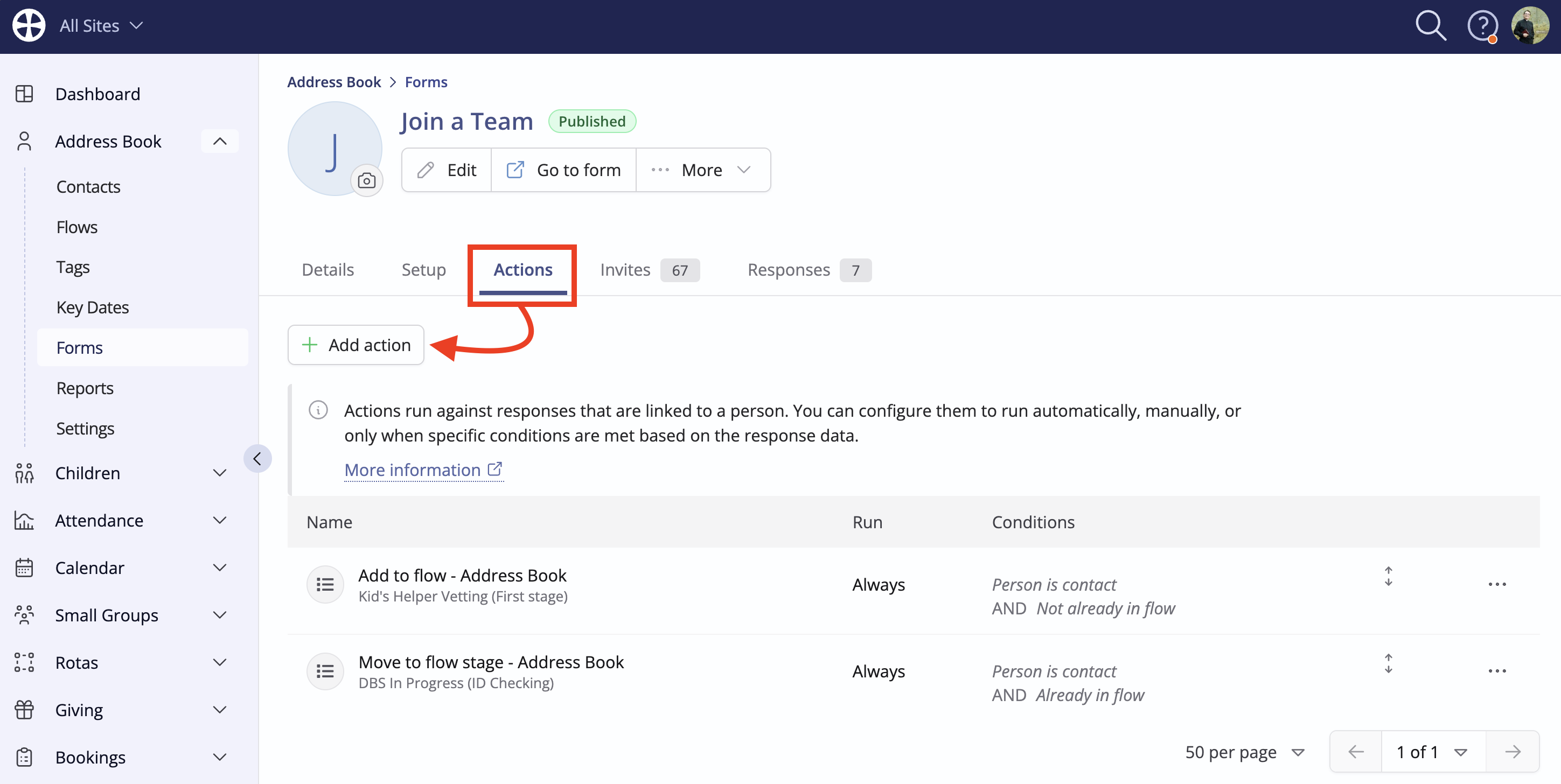
Actions are defined on the Actions tab on a form View. Click Add action.
The Add action pop-up shows the available actions for the module in which the Form is being viewed. For example, a Form in the Children module will show child actions.
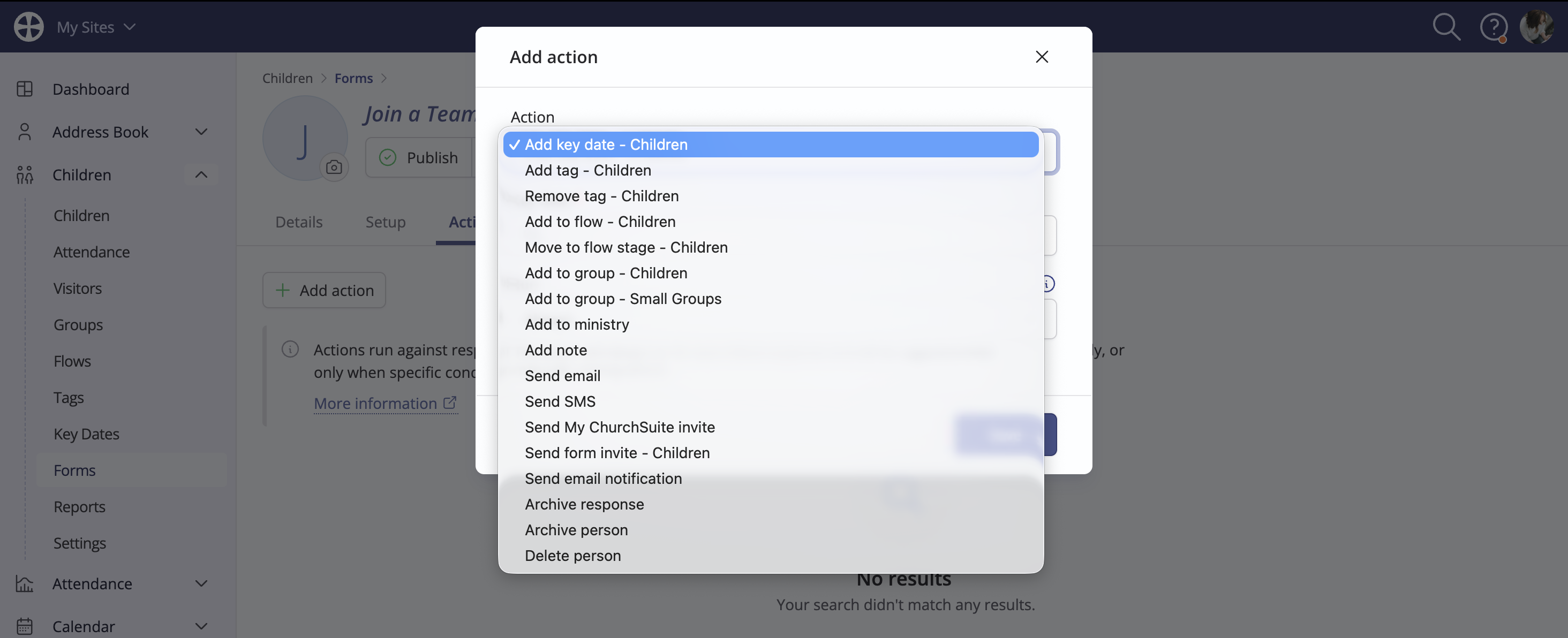
...whilst an Address Book form will show contact actions.
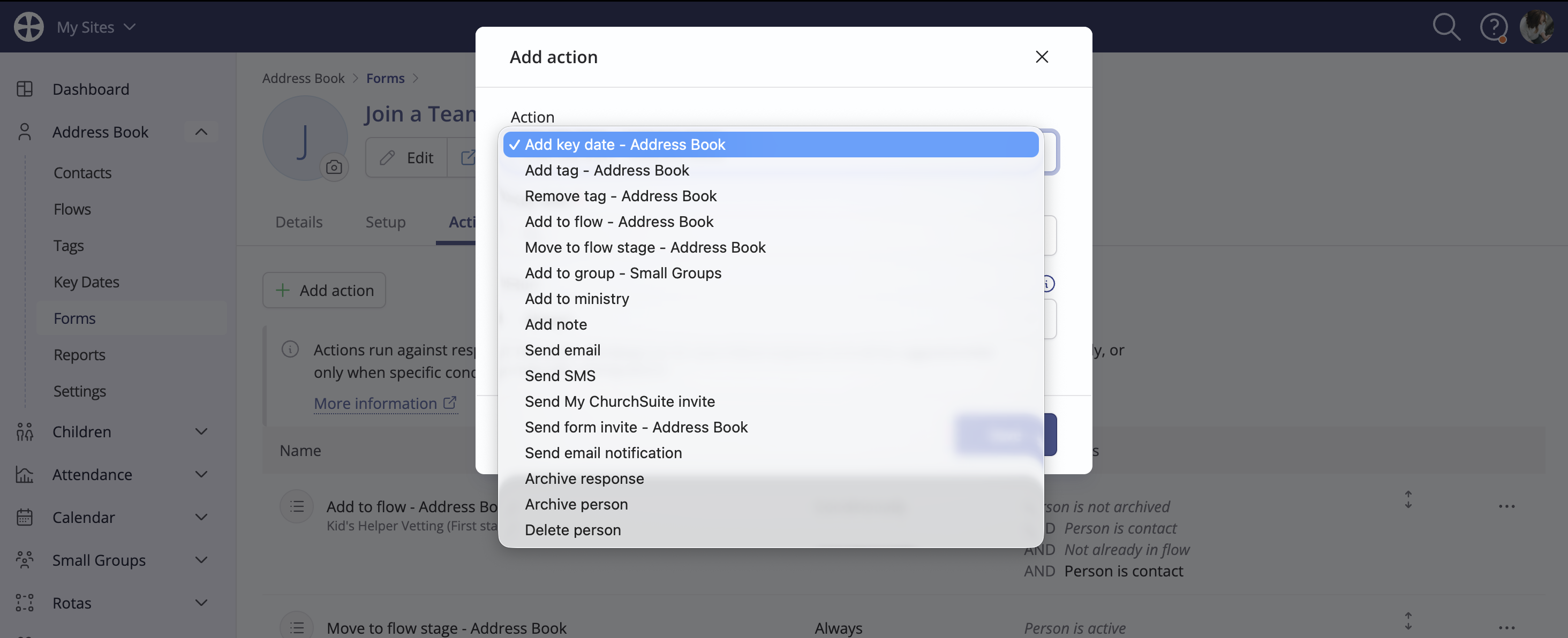
Note that selecting certain actions may reveal further options related to that action.
Next, choose when the action should Run - automatically (always or conditionally) or manually.
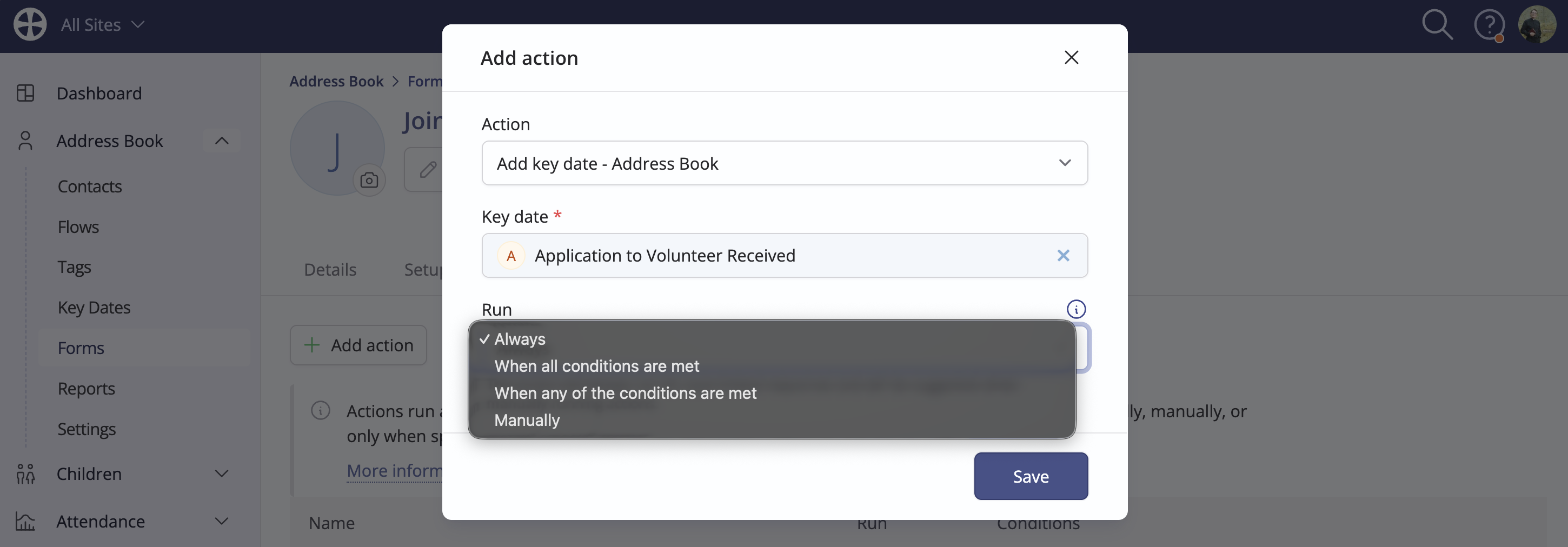
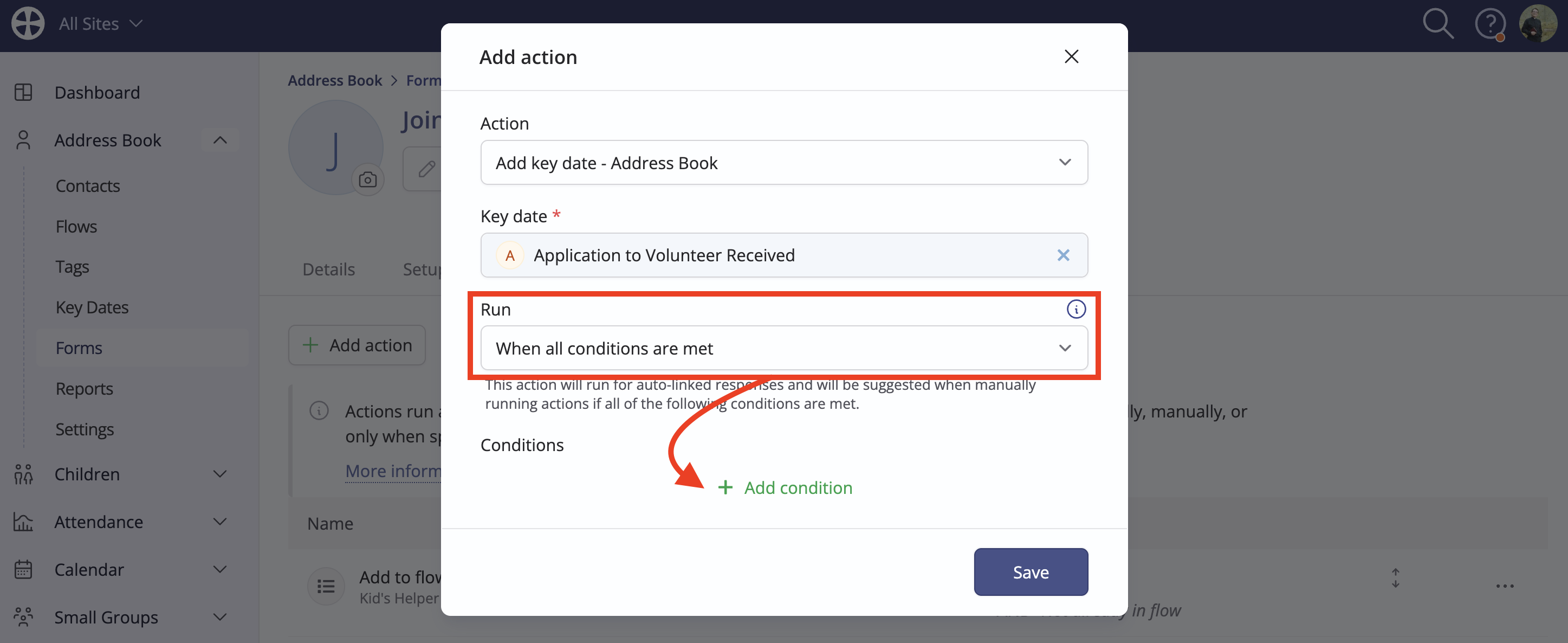
Conditional actions Run when any or all conditions are met. Click Add condition.
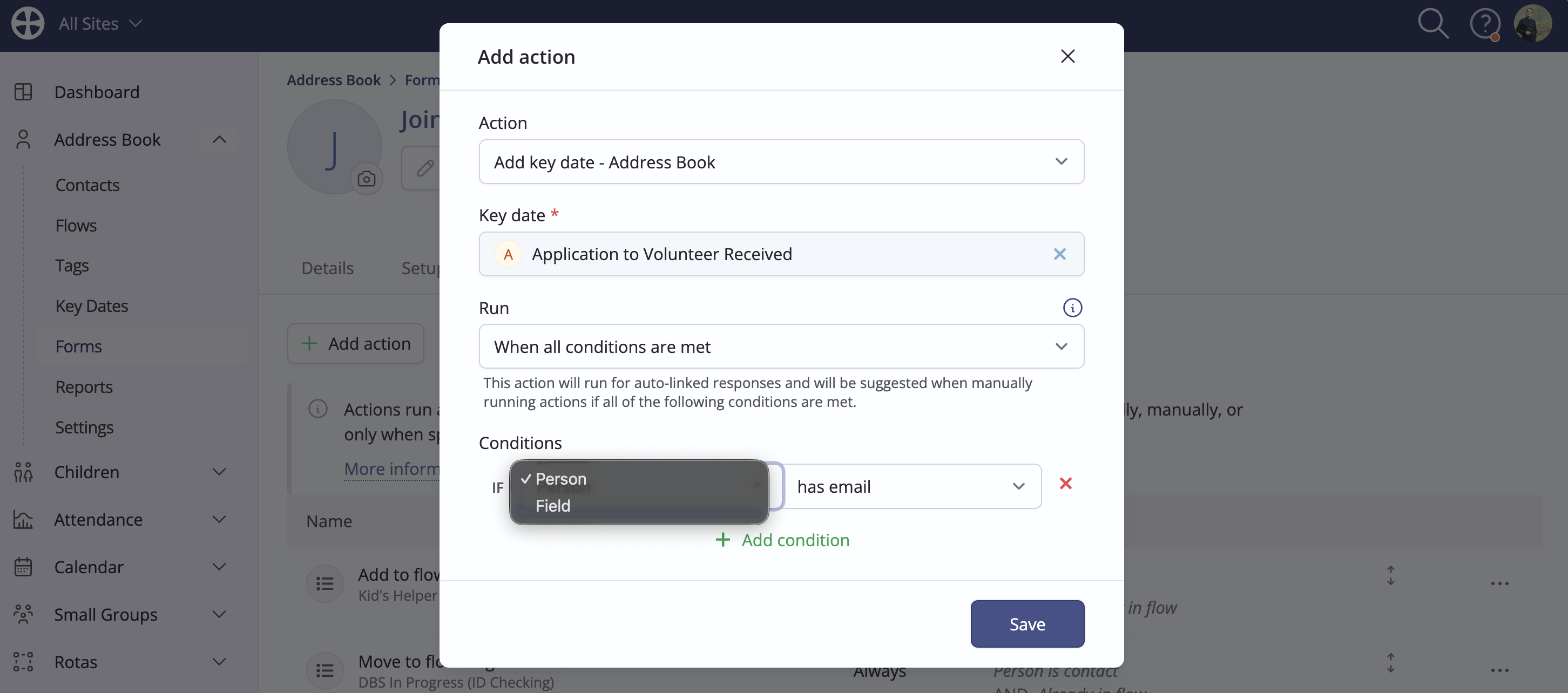
When adding conditions, select whether the action is conditional on the Person to whom the response is linked or to a response Field on the form:
For example, you might choose to conditionally assign a key date based on their response to a particular field on the form. In the following example, the key date is assigned if the "Hosting" option is selected for a certain Field on the form.
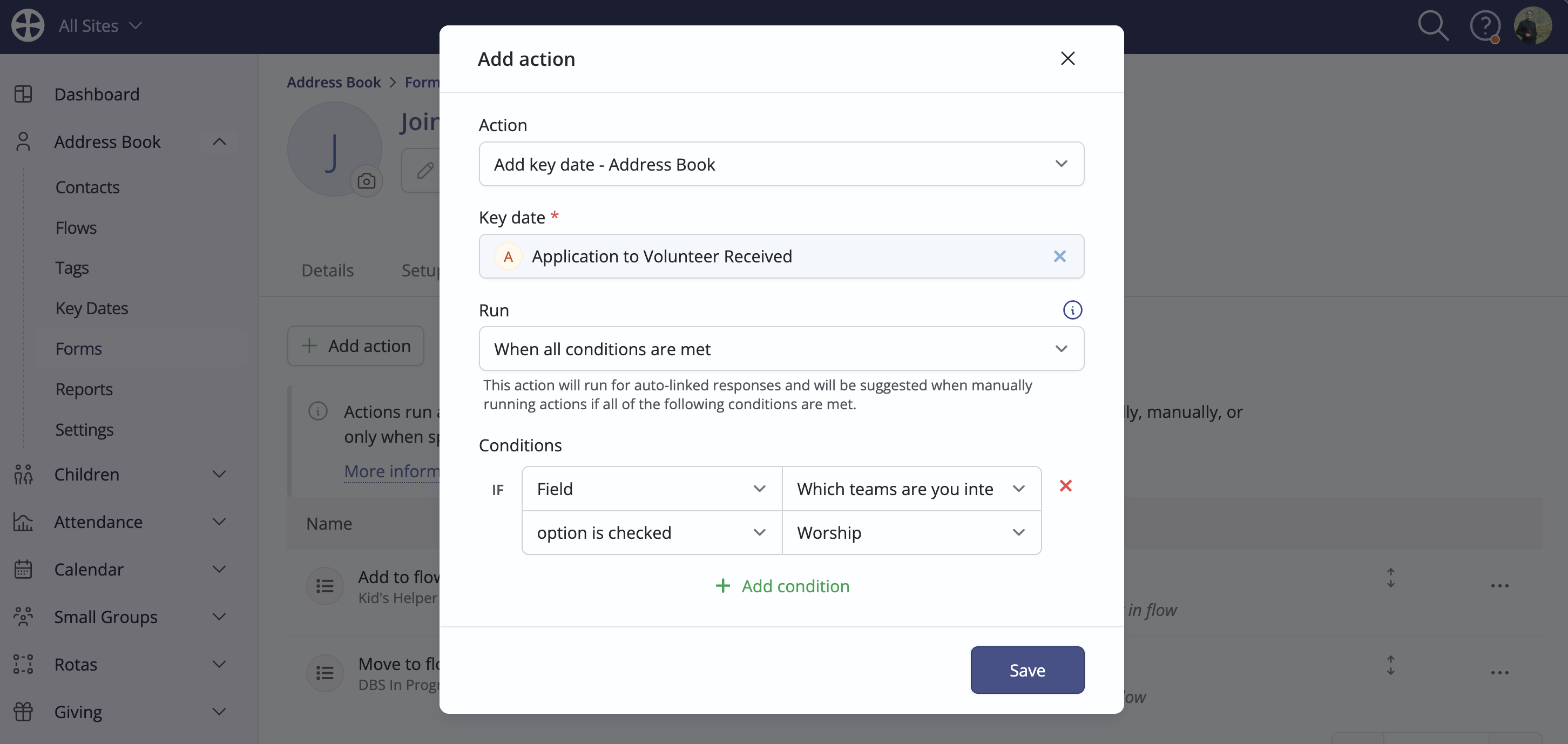
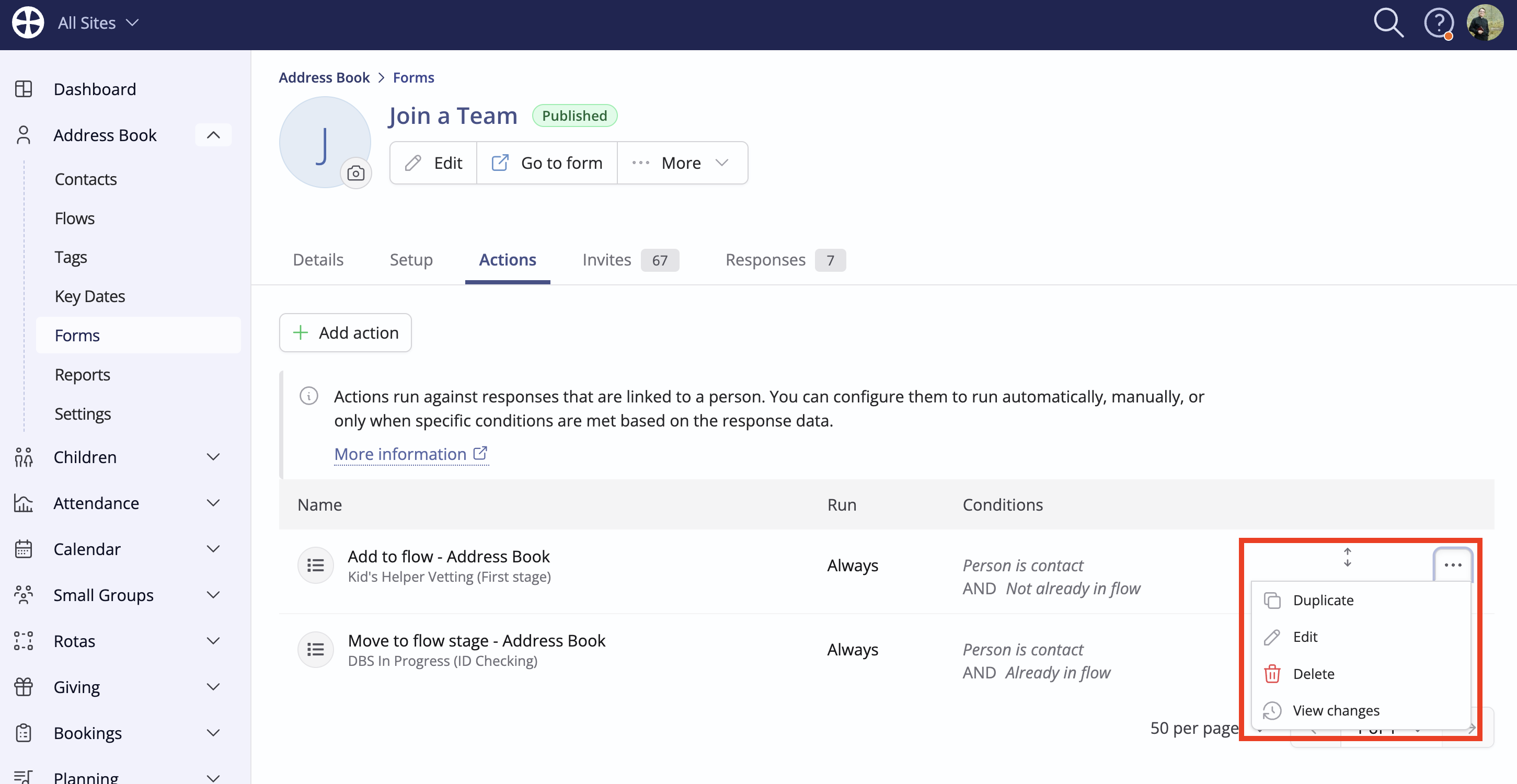
Continue adding further conditions as appropriate. Conditional actions are explored further in the next section. When finished, click Save to add the condition. Continue adding other Actions as needed. Finally, note the Actions to Duplicate, Edit and Delete a form action. Clicking View changes opens a pop-up showing the historical change logs for that action.
Conditional actions
As explained previously in this article, actions can be set to run automatically (always or conditionally) or manually. Automated actions will only run for responses that are auto-linked; however, actions can still be run manually by a module user for responses that are received "Unlinked". Let's consider the behaviour for the four Run options:
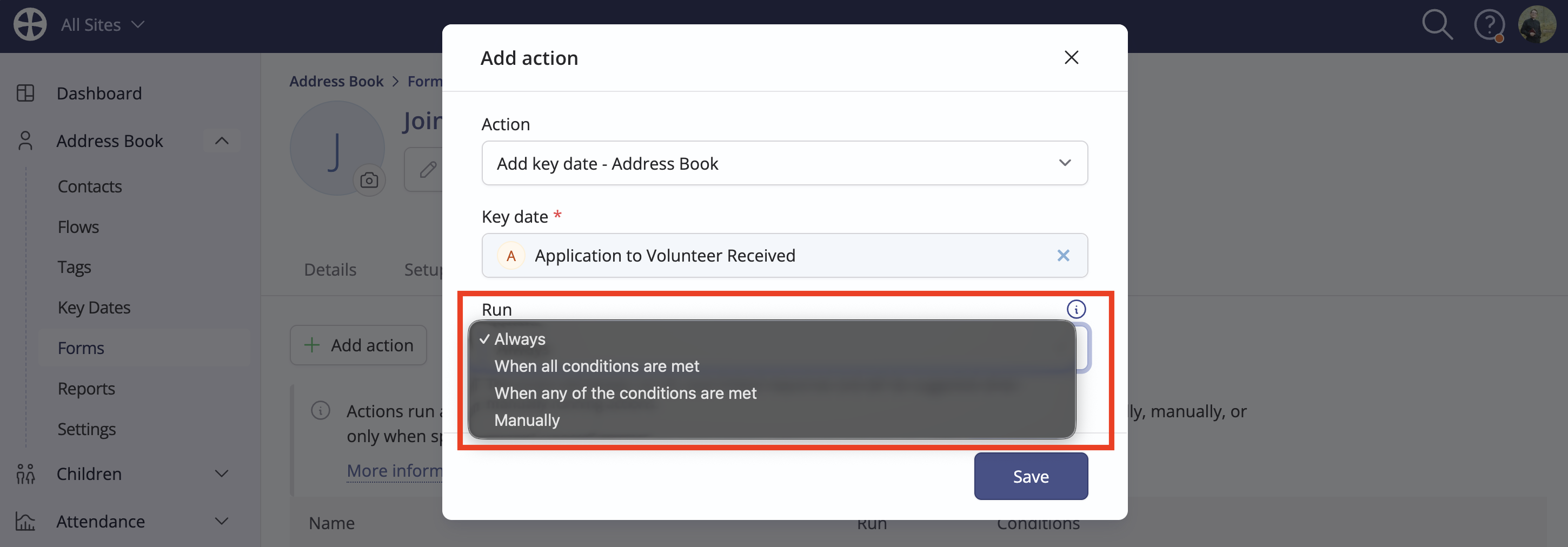
- Always—the action will run automatically for auto-linked responses; otherwise, it is a suggested (pre-selected) manual action once an unlinked response is linked to a person.
- When all conditions are met—the action will run automatically for auto-linked responses where the linked person meets all the conditions; otherwise, it is a suggested (pre-selected) manual action once an unlinked response is linked to a person and if that person meets all of the conditions.
- When any conditions are met— the action will run automatically for auto-linked responses where the linked person meets any conditions; otherwise, it is a suggested (pre-selected) manual action once an unlinked response is linked to a person and if that person meets any of the conditions.
- Manually— the action can be selected to run but it is not pre-selected as a suggested action, meaning a user can selectively choose the actions to run for the person on a response-by-response basis.
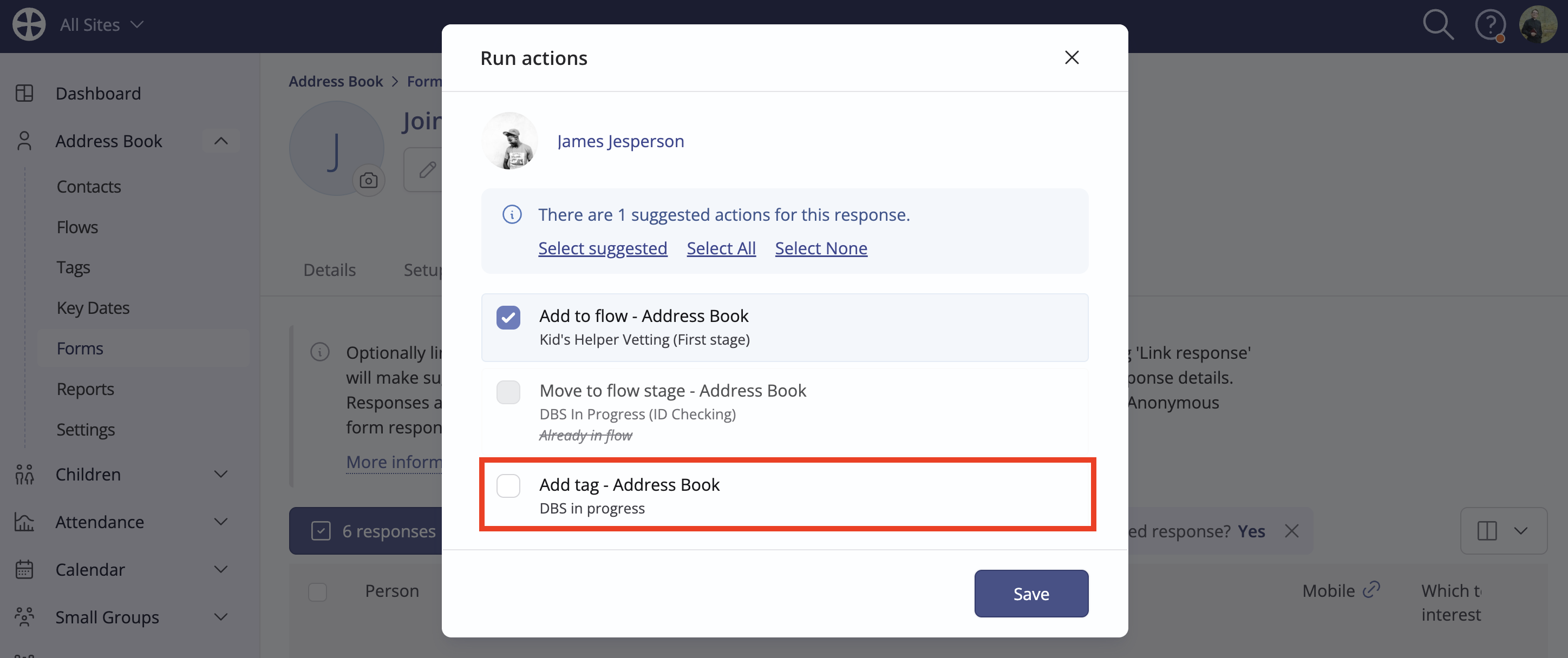
The example below shows a typical Run actions workflow. Suggested actions are pre-selected but actions set to run manually are not pre-selected; however, they can be optionally selected and run. Actions can only be run for Active form responses (not Archived responses) that are linked to a contact in the Address Book or a child in the Children module.
System-imposed conditions
The following system-imposed conditions must be met for certain actions to run:
- Archive Person - a person must be active
- Send Preset Email - a person must have an email address
- Send Preset SMS - a person must have a mobile number
- Add Key Date/Add Tag/Add to Flow/Remove Tag - Address Book - a person must be an active contact
- Add Key Date/Add Tag/Add to Flow/Remove Tag - Children - a person must be an active child
- Add to Flow - Address Book - the person must be an active contact and not already be in the flow
- Add to Flow - Children - the person must be an active child and not already be in the flow
- Move to Flow Stage - Address Book - the person must be an active contact already in the flow
- Move to Flow Stage - Children - the person must be an active child already in the flow
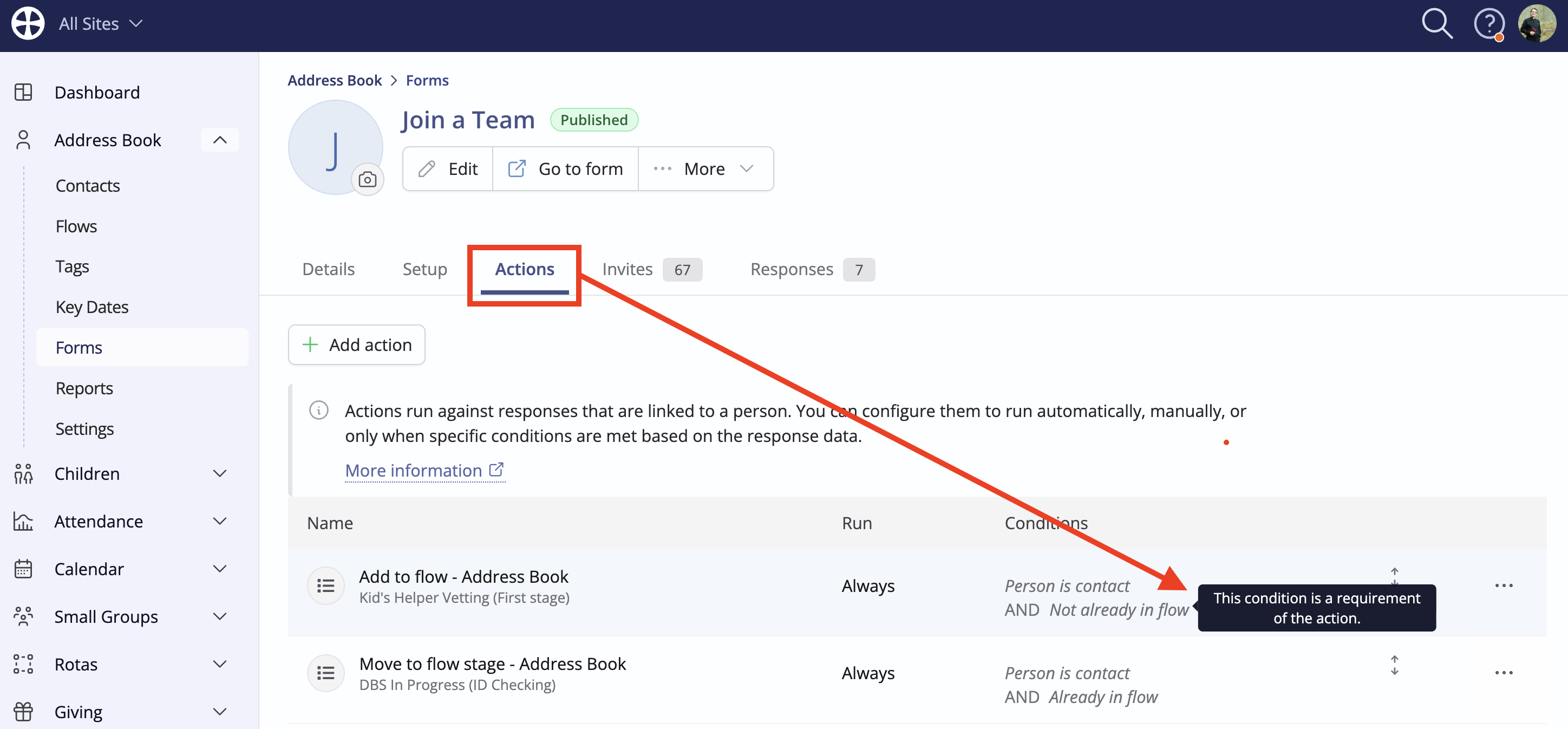
System-imposed Conditions are shown in italics when viewing the Actions tab. In the following example, the action will only run if action conditions are met AND the person is a contact in the Address Book (the system condition).
Making changes to fields linked to action conditions
It is entirely possible to make certain changes to the fields on a form; however, care should be taken as some changes may cause breaking changes to the form's actions.
Deleting a field from a form (or deleting a field option) - If a field or a field option is deleted, any conditions that relate to the deleted field or option will be removed. If there are no remaining conditions for an action, the action's Run settings are changed from conditional to Manually.
Archiving a field option - When a field option is Archived, respondents will no longer see that option when completing the form. Similarly, module users cannot add new conditional form actions referencing an archived field option. Any pre-existing actions conditional on an archived field option will no longer be suggested or pre-selected and a warning will be shown on the "Run actions" pop-up to alert the user that the option linked to the conditional action has been archived.
Running actions manually
Actions can only be run for linked responses. Actions can be set to run automatically (always or conditionally, for auto-linked responses only) or manually.
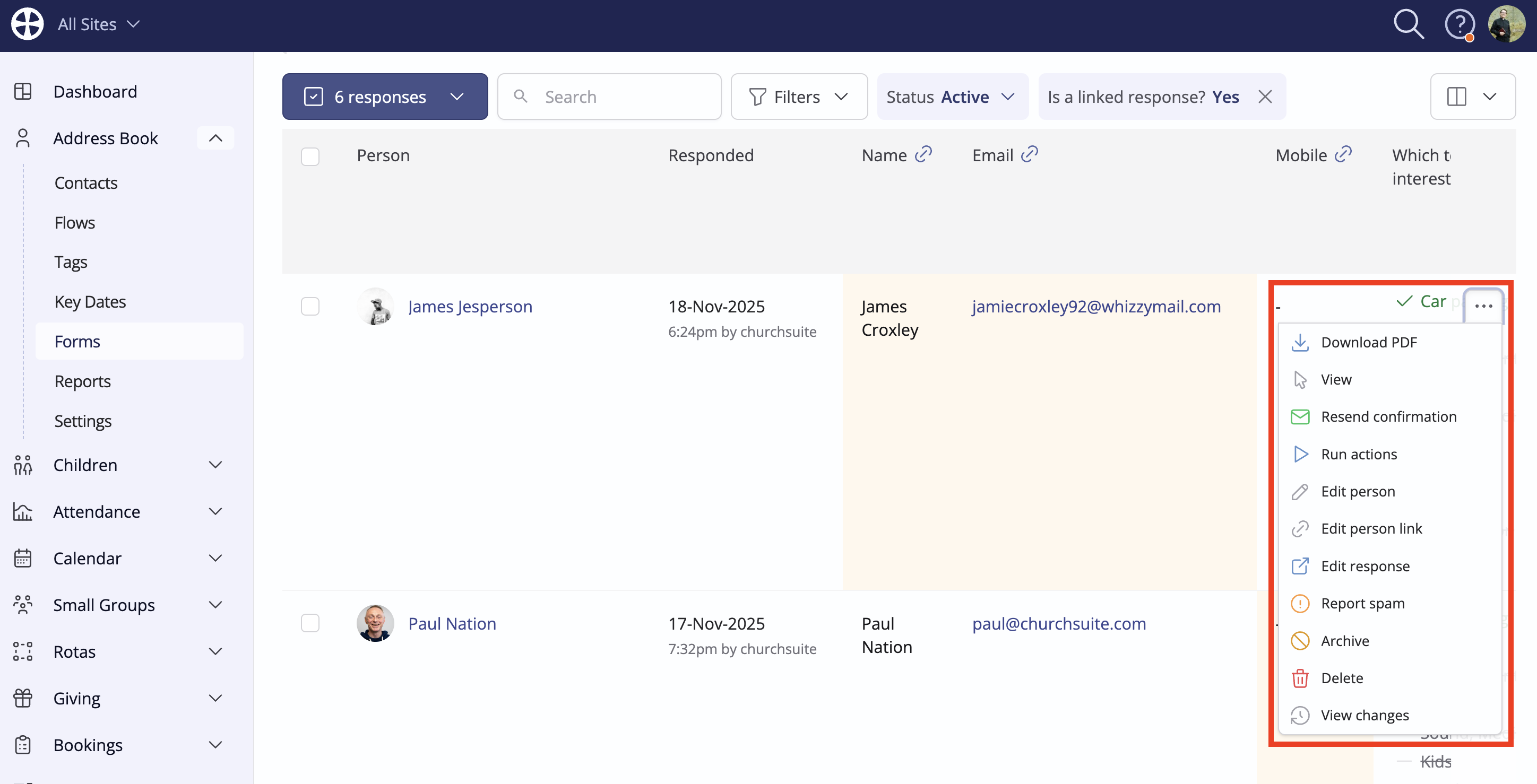
To manually run one or more actions for any individual linked response, and working from the Responses tab, select Run Actions:
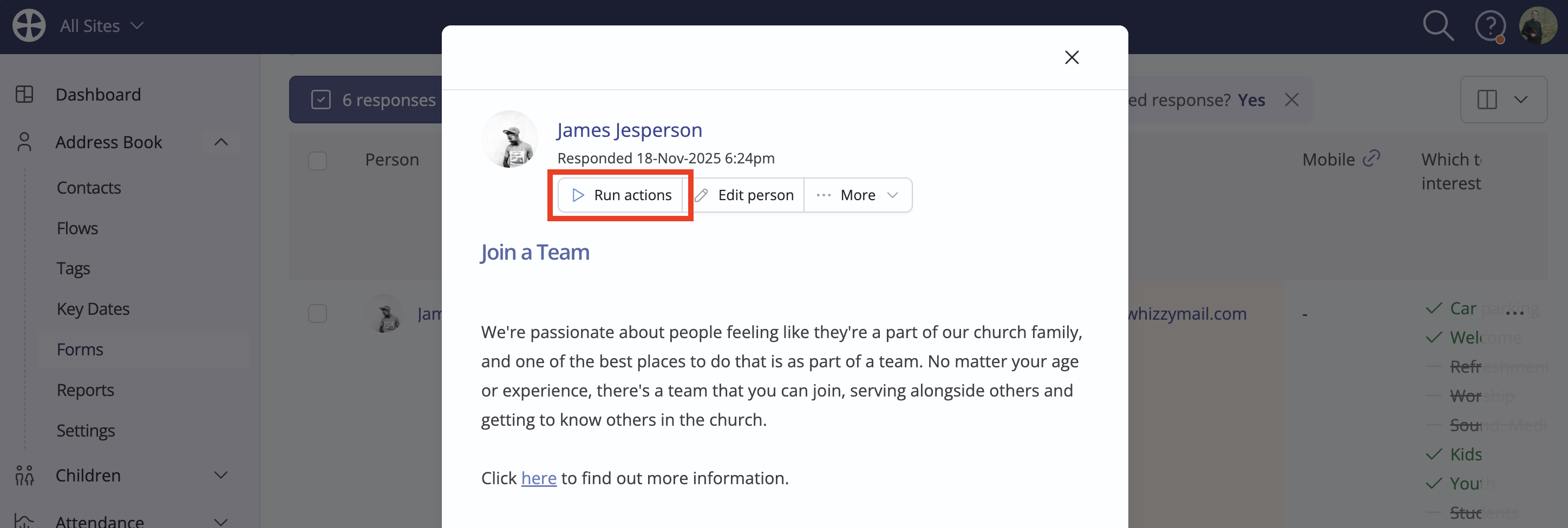
Run actions are also accessible on the response View pop-up when viewing a linked response pop-up:
Clicking 'Run Actions' opens a pop-up showing Suggested actions to run based on the person, their form response and the action conditions defined for the form, including any system-imposed conditions that have been met. Suggested actions are pre-selected but any action, including conditional actions that the person may not meet, can be selected or deselected. System-imposed conditions (explained earlier) must always be met for any action to be run; otherwise, the action is disabled in the list and cannot be selected or run. Action conditions are displayed with green text to indicate that the conditions are met and the action can be run if selected. Actions shown in strikethrough suggest that the action conditions have not been met and can be run if selected.
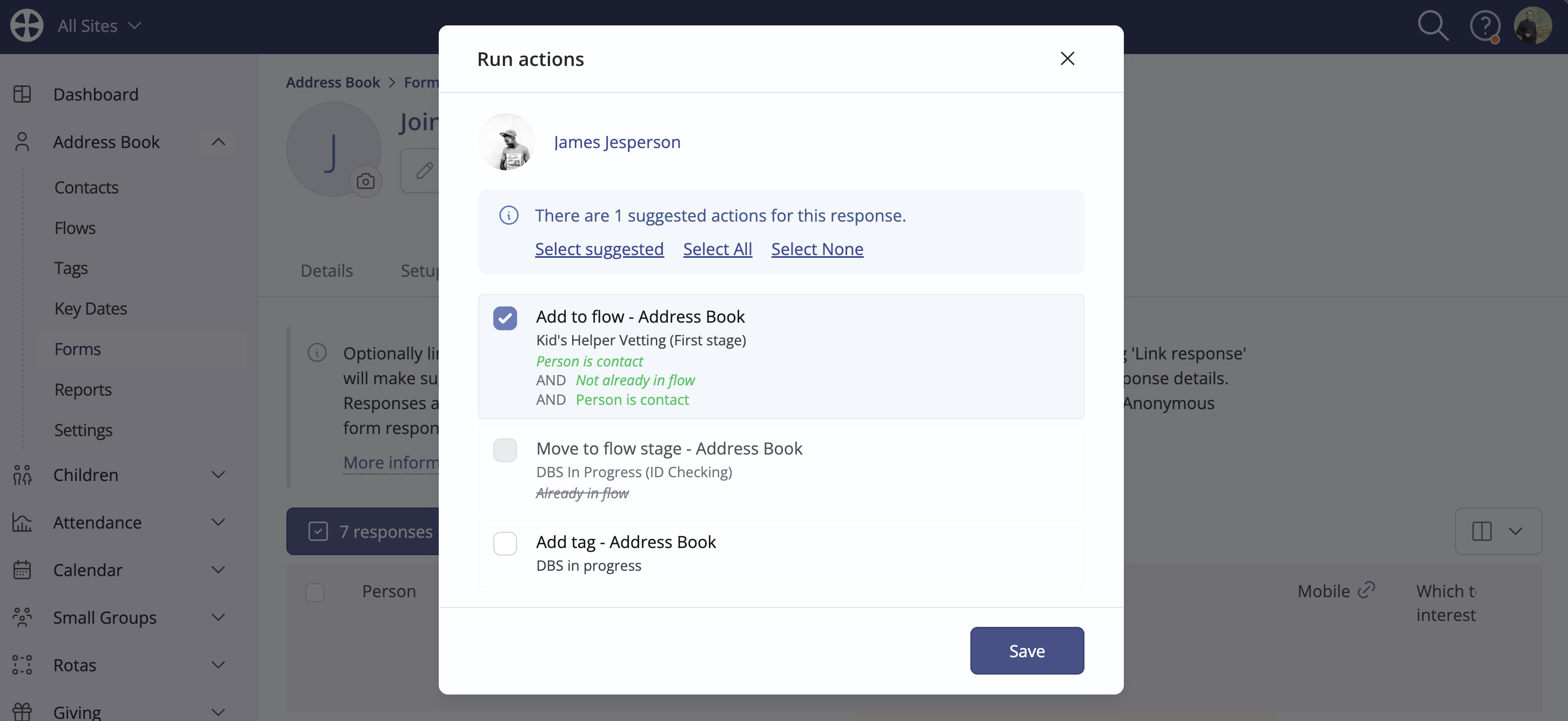
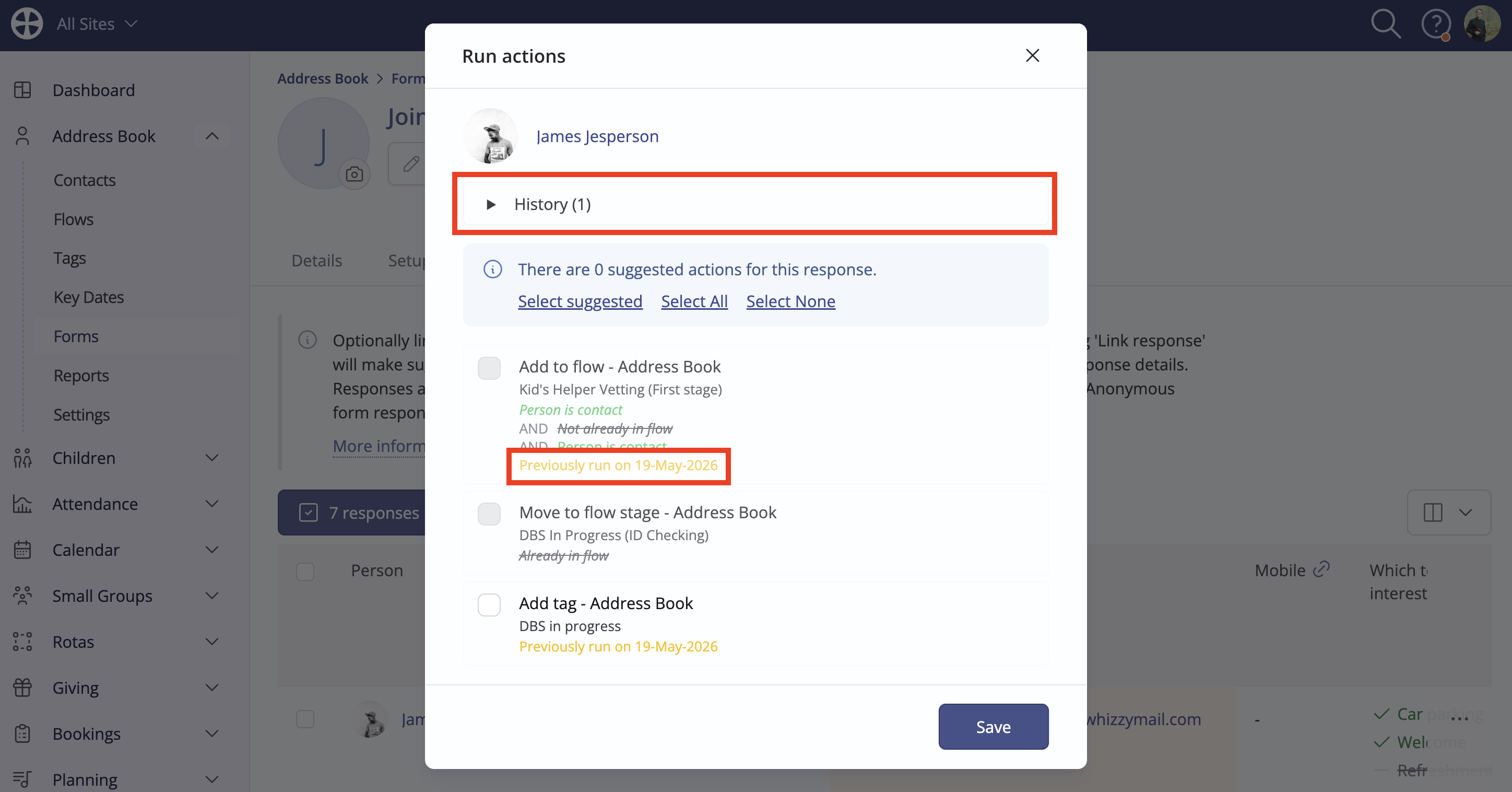
Any actions previously run are highlighted. Click History to view the action tracking data. Previously run actions are shown unselected but can be reselected and run again without constraint if you wish.
Top Tip! Get your actions in order!
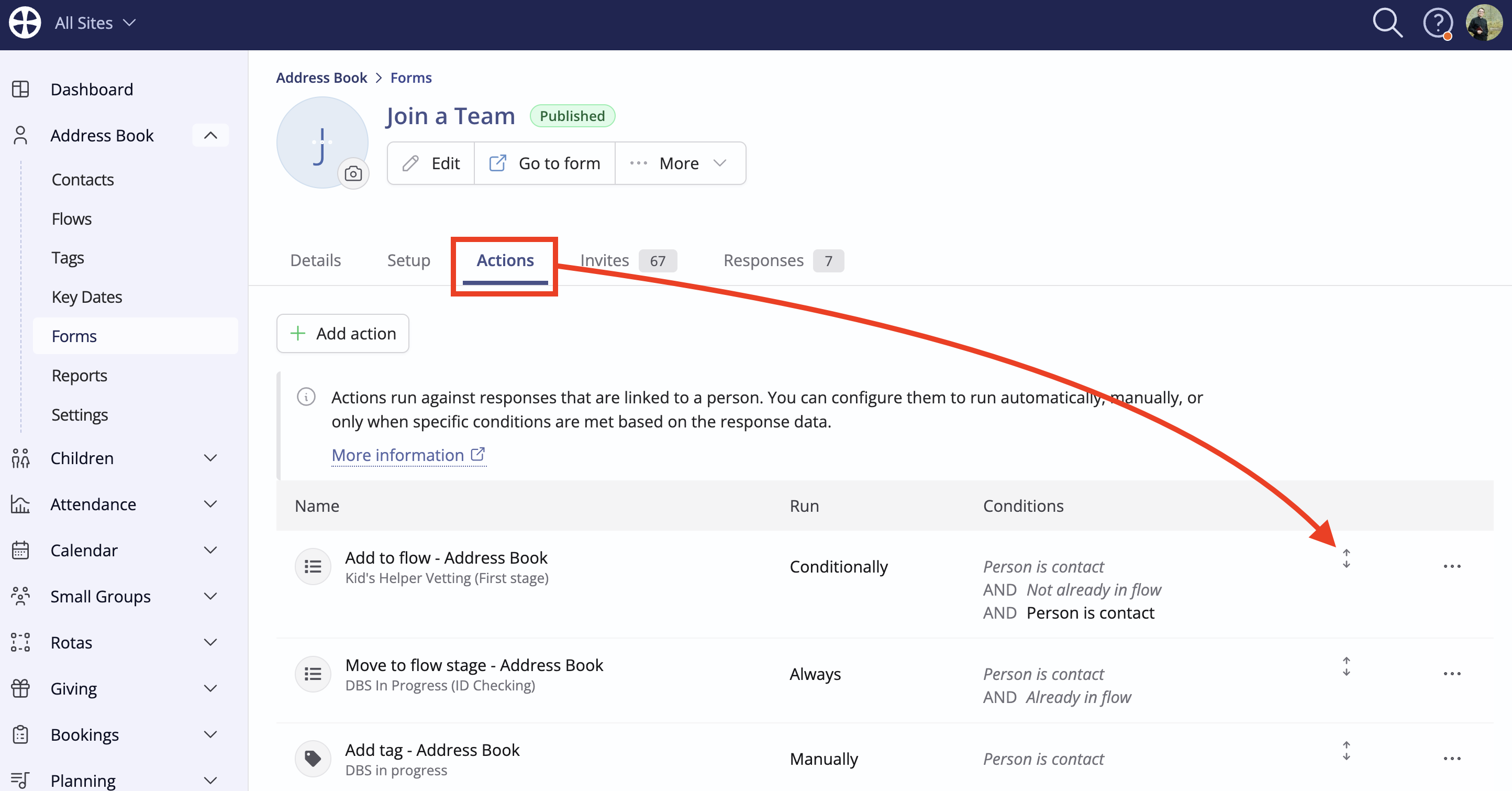
The order of actions is important. Actions are run in the order shown on the Actions tab. For example, if you want to send respondents an email and then archive them, the Send Preset Email action must be ordered before the Archive action; otherwise, the email action will fail because you cannot send emails to archived people. Click on any Order control to change the action order.
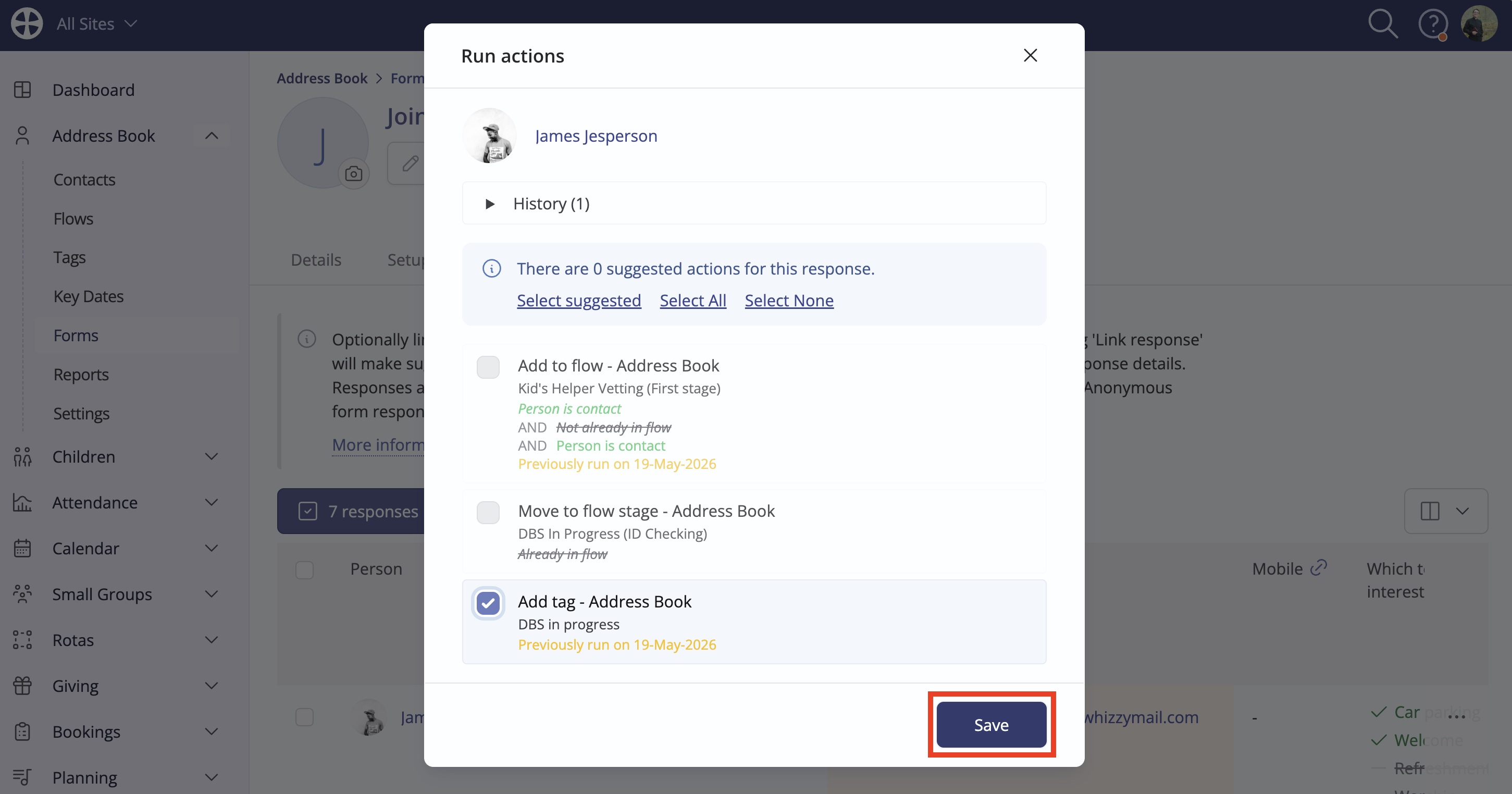
Click Save to run the selected actions.
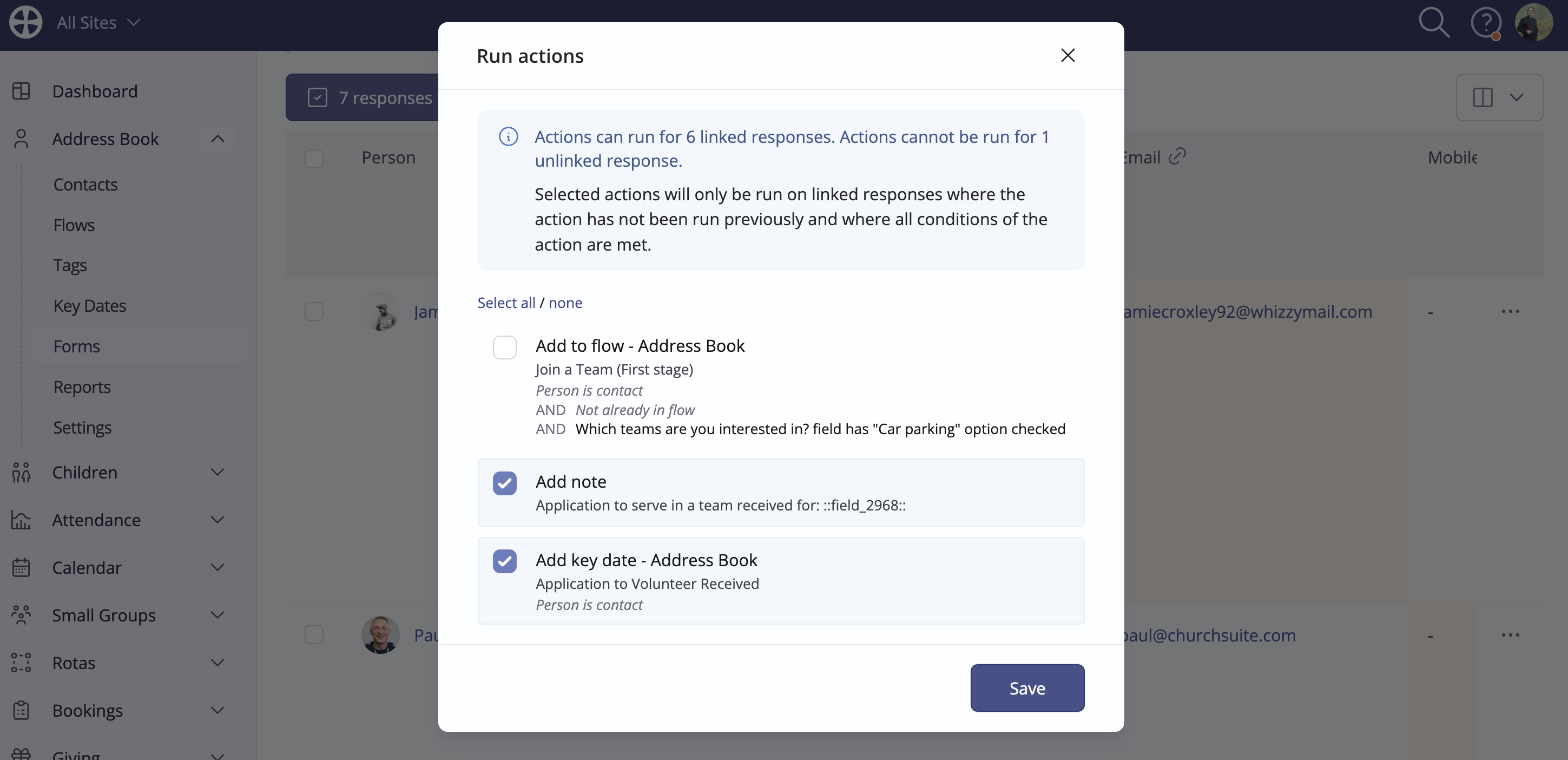
Actions can also be run for multiple form responses using the bulk actions and clicking Run actions.
Clicking Run Actions' opens a pop-up showing Suggested actions to run. Suggested actions are pre-selected but any action can be selected or deselected. Selected actions will only be run on linked responses where the action has not been run previously and where all conditions of the action are met.